A Swing Trader Who Trades with His Head
Andrey trades almost every instrument available on Hash Hedge, but avoids illiquid altcoins.
His main timeframes are 1H, 4H, and 1D. He takes both long and short positions, primarily trading with the trend.
His strategy is based on Price Action and his own observations of the market.
Andrey identifies key zones on higher timeframes and refines his entries on lower ones. He deliberately avoids short-term intraday trading.
According to him, price movements appear more significant on lower timeframes, but market noise also increases. This encourages traders to open more positions and, consequently, take more risks.
From Binary Options to Futures
About five years ago, Andrey decided to try trading because he wanted to earn a living through mental rather than physical work.
He started with binary options and also invested through an individual investment account (IIA). Neither approach worked for him.
He was particularly concerned about the math behind binary options:
“Binary options have a negative expected value: you risk more than you can earn. You risk 100 rubles, but if your prediction is correct, you only get 80. And you have to do that over and over again. The math just doesn’t add up.”
Later, Andrey started building a spot portfolio on a major exchange. He was initially cautious about futures, so he decided to experiment with just $10.
Liquidations involving small amounts didn’t cause significant losses, but they helped him understand why liquidations happen.
Over time, Andrey realized that using isolated margin allowed him to limit losses to the amount allocated to a position.
This gave him confidence. He began taking on more risk and opening larger positions. Eventually, however, that very confidence became a trap.
October 11: His Portfolio Was Wiped Out in Half an Hour
Andrey used his spot portfolio as collateral for trading with 2–3x leverage. But on October 11, 2025, he lost his entire collateral portfolio in just half an hour.
He was at a bar at the time. When he opened the app to check his account, he saw that many assets had plunged by 80% within an hour.
“All I said was, ‘Thanks, but I’m out.’”
Andrey admits that dealing with such a loss was emotionally difficult. Your familiar view of the world falls apart, and until you find something new to hold on to, coping with it isn’t easy.
Eventually, he came to a firm conclusion: if an asset can lose 80% of its value in an hour, risking his own money on it simply doesn’t make sense.
According to Andrey, futures can also become dangerous when traders fail to follow risk management rules.
How Andrey Joined Hash Hedge and Received 4 Payouts
That same evening, Andrey came across a YouTube video in which traders who had also experienced liquidation recommended trying Hash Hedge.
The idea caught his attention: prop trading offers access to trading capital without putting large amounts of personal money at risk.
“What’s the point of depositing $10,000 when you can just buy a Challenge and trade?”
Andrey lost his first trading deposits because he wasn’t managing risk properly. It was his own money, and that loss ultimately led him to prop trading.
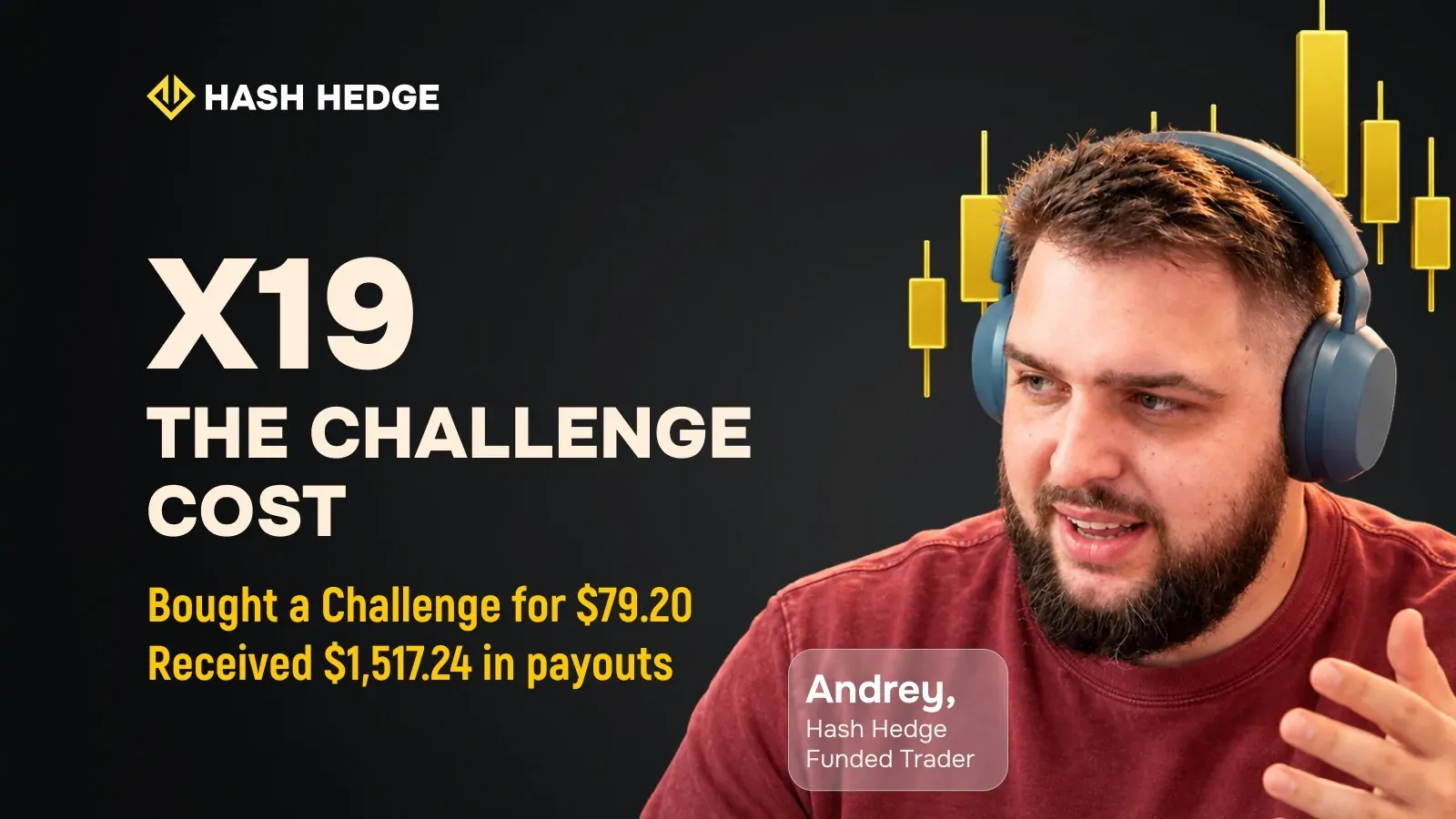
At the time of the interview, Andrey had purchased just one $10,000 Challenge, which cost him $79.20 with a discount.
Using his strategy, he qualified for a Funded Account and successfully received four payouts to his Wallet:
Payouts: $280.84, $408.40, $238, and $590
Total: $1,517.24




He intentionally requested a small first payout because he wanted to make sure the system worked and that the money would actually arrive. Initially, he had doubts.
“A payout is just another payout. It’s not a celebration or a gift. It’s still work, still learning.”
Now Andrey treats every payout as a normal result of his work, rather than a reason to relax.
He sees trading less as a profession and more as a skill that anyone can develop by dedicating enough time to it.
Swing Trading: Higher-Timeframe Analysis and Finding Entry Points
Andrey’s trading strategy is fairly straightforward.
He’s a swing trader, holding positions for a day or longer and identifying key zones on higher timeframes. He refines his entries on lower timeframes but avoids short-term intraday trading. In his experience, trading on smaller timeframes starts to feel more like gambling.
His approach is based on Price Action, local highs and lows, liquidity zones, and key price levels.
Andrey also uses trading volume and indicators such as MACD, Stochastic, and RSI.
He only looks for divergences on the 1-hour timeframe and above, since these signals are more likely to be false on lower timeframes.
Here’s how he enters a trade: First, Andrey identifies a key zone on a higher timeframe. Then he moves to a lower timeframe to find an entry, looking at liquidity sweeps, trading volume, and oscillator signals.
When the price reaches his target zone, he waits for momentum to slow down and for the market to show a reaction in the opposite direction.
Andrey believes most news is already priced into the market. In his opinion, unexpected interest rate decisions are one of the few exceptions. He uses TradingView for chart analysis.
Another tool in his strategy is price imbalances.
For example, Andrey identified an important imbalance zone around $81,000 on Bitcoin’s daily chart. When the price reached that level and showed a reaction, he saw an opportunity to gradually build a position.
Risk Management: 1% Risk per Trade and a 2:1 Reward-to-Risk Ratio
Andrey typically risks 1% per trade, aiming for a potential profit of at least twice the amount he could lose.
In his most recent Bitcoin trade, he increased his risk to 2% because the price had reached a significant zone on a higher timeframe, either daily or weekly.
According to Andrey, swing trading makes risk management easier. Positions stay open for more than a day, and having a predefined trading plan helps him avoid making decisions based on short-term market movements.
“If you’re trading without managing risk, without understanding how much you could lose, it’s basically the same as walking into a casino and playing roulette. But if you’ve set a rule that you won’t lose more than $100 today, that’s it. No exceptions. It’s better to be frustrated than to break your risk limit.”
Prop Trading, Gambling, and “Friday Casino”
Andrey believes prop trading helps traders manage their emotions. The rules and limits encourage discipline and make it easier to avoid impulsive decisions.
At the same time, he doesn’t see a fundamental difference between trading personal capital and trading a prop account once a trader has mastered risk management.
Andrey admits that he’s familiar with the urge to recover losses:
“You want to win it back. That pressure is real.”
One reason he avoids short-term trading on lower timeframes is that it creates a stronger temptation to keep clicking and opening more trades. In prop trading, that behavior can cost you your account.
“The casino only opens on Fridays, so to speak. The fewer trades I open, the less I can potentially lose.”
Andrey’s main advice for beginners is to learn how to manage risk first.
In his opinion, risk management is one of the biggest challenges for new traders.
Prop trading can be a good starting point, but he believes it’s important to distinguish between complete beginners and experienced traders who simply don’t have enough personal capital yet.
Financial Freedom, Inner Demons, and Advice After Liquidation
For Andrey, financial freedom means earning $5,000–$6,000 per month per person.
But it’s not just about money. It’s also about having the freedom to travel and live anywhere in the world.
He spent his most recent payout on a new TV, although it turned out to be defective.
“Just for myself. Purely for enjoyment.”
Looking ahead, Andrey plans to increase both the number and size of his trading accounts while sticking to the same strategy and risk management rules.
Beyond money, the most important thing trading has taught him is to recognize his own weaknesses: greed, the urge to gamble, and the tendency to lose control over his decisions.
As Andrey puts it:
“Acknowledging the problem is the first step.”
For anyone who has just experienced liquidation, Andrey’s advice is simple: close the charts and stop watching the market.
The loss has already happened, and constantly checking the price won’t change anything.
According to him, mistakes in trading are simply:
“Part of the job. Part of the journey.”
Key Takeaways
1. A Simple Strategy Doesn’t Need to Be Complicated
Andrey deliberately avoids short-term intraday trading to resist the temptation to constantly open new positions.
He identifies key zones on higher timeframes and uses lower timeframes only to refine his entries.
2. Risk Management Matters More Than Your Trading Setup
Andrey lost his first trading deposits because he wasn’t managing risk.
His results improved after he established clear rules: typically risking no more than 1% per trade and targeting potential profits at least twice as large as his potential losses.
3. Fewer Trades Mean Fewer Opportunities to Gamble
Andrey intentionally moved away from lower timeframes to avoid impulsive trades and unnecessary risk driven by the urge to constantly be in the market.
4. A Payout Is the Result of Your Work, Not a Reason to Relax
He treats every payout as a normal part of trading and continues following his strategy and risk management rules.