





←
Hash Hedge Blog
RISK MATTERS MORE THAN STRATEGY
How an Engineer from Côte d’Ivoire Became a Trader and Earned $7,422 on Hash Hedge
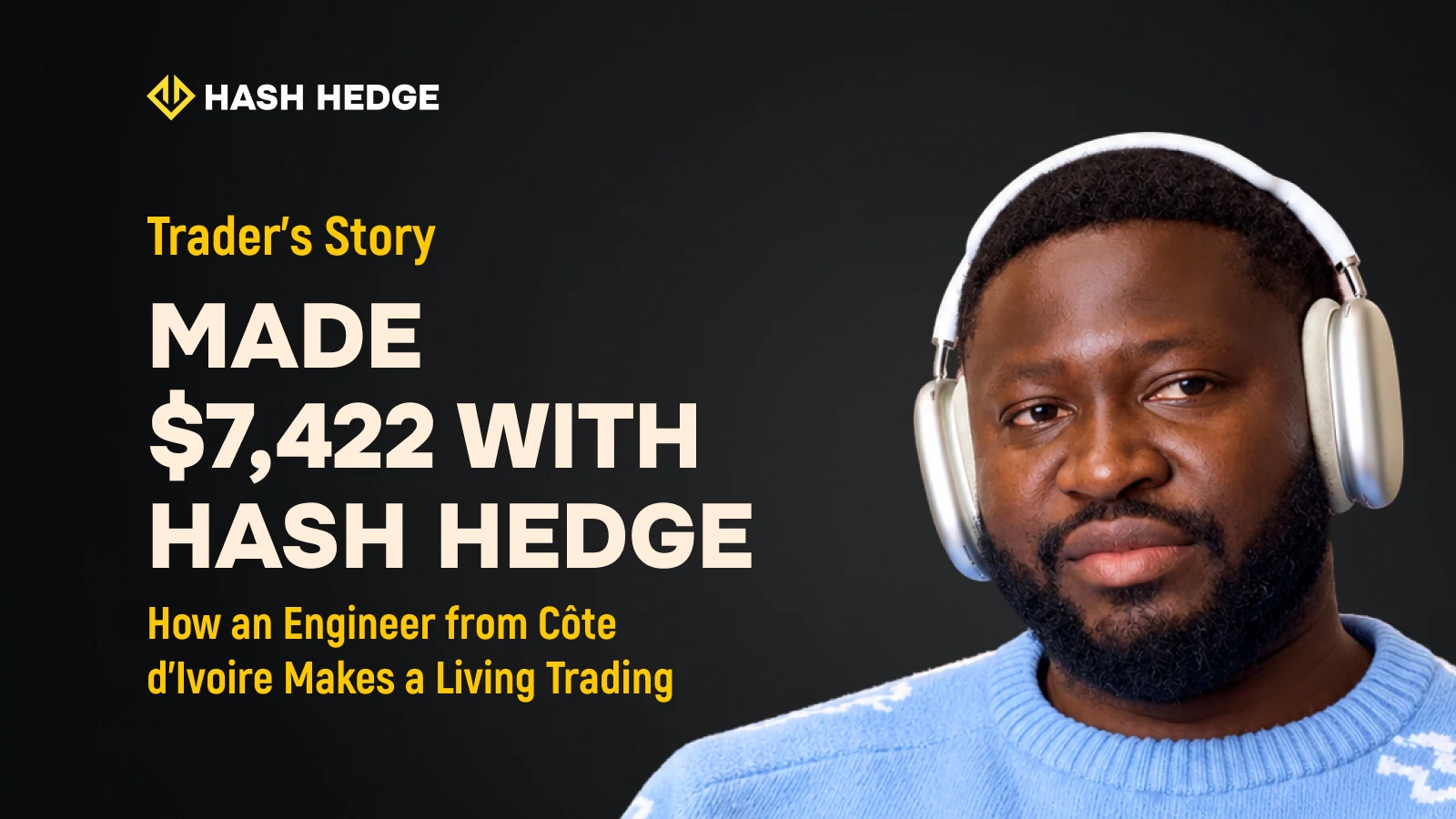
In 2014, Adama moved from Côte d’Ivoire to Russia to study. Today he lives in Moscow, works as a civil engineer, and has recently completed his postgraduate studies.
Yet for the past 3-4 years, his main source of income has been trading.
On Hash Hedge, Adama has already received 3 payouts totaling $7,422.
His strategy is built around tracking the footprints of large market participants. Adama analyzes where liquidity may be sitting and price reacts after liquidity has been swept.
In this interview, he talks about how he lost the money he had saved for his education, why he quit binary options, how he built his trading system, and what helps him make money from trading.
Contents
From Côte d’Ivoire to Moscow: How Adama Got into Trading
Binary Options and Losing His Tuition Money
Prop Trading: From Early Failures to 3 Payouts
The “Follow the Big Player” Strategy
Smart Money: Liquidity, Manipulation, and Entry Confirmation
Trading Discipline: Exercise, Affirmations, and a Daily Plan
Risk Management: No More Than 2% per Trade
Making a Living from Trading
Key Takeaways
From Côte d’Ivoire to Moscow: How Adama Got into Trading
In 2014, Adama moved from Côte d’Ivoire to Russia to get an education. He chose civil engineering and stayed on in Moscow.
His first years in a new country weren’t easy. Alongside his studies, Adama began thinking about extra income and financial independence.
In 2016, he became interested in trading. Back then, he had no idea that trading the financial markets would one day become his main source of income.
Today he has around 10 years of experience behind him. For the past 3-4 years, Adama has supported himself entirely through trading, while continuing his education.
In 2026, he completed his postgraduate studies in civil engineering.
The main reason Adama chose to focus on trading was financial independence.
For him, it means being able to make his own decisions, manage his own time, and depend less on outside circumstances.
But before trading became his main source of income, he had to go through some serious financial losses.
Binary Options and Losing His Tuition Money
When he started out, Adama knew next to nothing about the financial markets.
He began with a small deposit of $100-200.
On his very first day, he managed to double his account. The quick win gave him the impression that making money from trading was easier than it actually turned out to be.
“I started topping up little by little: $50, $100. Sometimes I’d win and withdraw, sometimes I’d lose more.”
His biggest mistake came in 2017-2018.
Adama traded with money he had been saving for his education. After the first loss, he topped up his account again, hoping to win it back. In the end, he lost that money too.
“I was losing a lot of money, but I didn’t stop,” he recalls.
He later realized the problem wasn’t just bad trades.
He had no trading system, no risk management rules, and no control over his emotions.
His decisions were impulsive, and the urge to win back what he’d lost only led to new losses.
That experience forced Adama to change his approach. He began studying technical analysis, risk management, and trading psychology more seriously.
Over time, he gave up binary options. One of the reasons was the constant stress that comes with that kind of trading.
His next step was Forex, which he has now been trading for more than 3 years.
In the currency market, a different approach suited him better: do the analysis, define the entry conditions, place the order, and wait for the outcome, without letting emotions drive every decision.
Later, Adama started trading crypto and found that the principles of his strategy can be applied to both Bitcoin and altcoins.
That said, he takes the differences between instruments into account, above all their volatility, and sizes each position based on a risk he sets in advance.
This is how Adama gradually arrived at the core principle of his trading: finding a good entry isn’t enough. You have to control your risk and stick to your own rules.
Prop Trading: From Early Failures to 3 Payouts
For a long time, Adama was skeptical of prop trading. He had tried other prop firms before and came away disappointed: he could make a profit, but withdrawing it was always a struggle.
After that, Adama decided to give up on prop trading altogether and even stopped paying attention to prop firm ads.
Then he came across a video about Hash Hedge on YouTube and decided to give prop trading one more chance.
Even a rocky start didn’t put him off:
First, Adama bought a $5K challenge for $99 but didn’t pass it.
After that failure, he decided to try again:
He bought another $5K challenge, but that attempt didn’t work out either.
Adama dug deeper into the details of prop trading and decided to go for a bigger challenge.
His third was a $25K challenge.
This time he passed, made it to a Funded account, and received his first payout of $1,178:

That same month, Adama received his second payout of $2,664:

After that, he decided to take on another challenge, this time with more capital. He went with a $50K account.
It was on this account that he received his biggest payout yet, $3,580:

In total, Adama has received 3 payouts on Hash Hedge totaling $7,422
His approach to trading has barely changed. Adama kept using the same strategy but adapted his risk management to the prop firm’s rules.
He pays particular attention to the daily loss limit.
For example, on a $50,000 account with a daily loss limit of 3% ($1,500), Adama prefers to use only 10% of that limit, capping his daily risk at $150.
For Adama, the drawdown limit isn’t an amount to be used up. It’s a line best never reached.
At the same time, Adama refuses on principle to trade on demo accounts. Even when testing new conditions, he prefers to trade real money, just with reduced risk.
The company’s Telegram channel gave him extra confidence in Hash Hedge: there he saw other traders’ results and details of their payouts.
Going forward, Adama plans to gradually scale up his trading capital, moving on to $100,000 and $200,000 accounts.
The biggest thing that changed after he discovered Hash Hedge was his attitude toward prop trading.
“I never used to trust prop firms. Now I know that Hash Hedge really pays out.”
The “Follow the Big Player” Strategy
Adama sums up his trading approach simply:
“I just follow the professionals, the big players.”
His main analytical tool is trading volume. He uses it to figure out where large market participants are active.
“When there’s volume and a result, that’s a professional.”
By “result,” Adama means a strong price move accompanied by high volume. In his view, this combination can signal large capital at work and helps him spot zones for a potential entry.
Adama primarily trades range-based setups, going both long and short. His main assets are BTC, ETH, and SOL.
He starts his analysis on the higher timeframes: the daily and the 4-hour. After each candle closes, he assesses the market structure, volume, and the likely direction of the move.
Once the trade scenario is clear, he drops down to the lower timeframes (1-hour, 30-minute, or 15-minute) to pinpoint a more precise entry and set his stop-loss level.
Smart Money: Manipulation, Volume, and Entry Confirmation
One of Adama’s core setups involves trading within a range:
First, price forms the boundaries of the range and tests support or resistance several times. Then it breaks out beyond the boundary, a move Adama treats as a possible manipulation and liquidity grab.
But a breakout on its own isn’t an entry signal for him. Adama waits for confirmation: a strong candle on increased volume.
His trade scenario looks like this:
1
The range forms.
Price tests a key zone several times.
2
Price breaks the boundary.
It moves beyond the level, which may be a liquidity grab.
3
Volume confirms.
Adama assesses the strength of the move and how price reacts to gauge possible big-player activity.
4
He enters the trade.
Once confirmed, he opens the position and places his stop-loss beyond the zone the scenario is built on.
After entering, Adama may trail his stop behind price to lock in profits.
“When there’s volume and a result, the big player isn’t sitting still, and that’s exactly where I get in.”
That said, Adama admits that even a strong, high-volume move doesn’t guarantee continuation. False signals happen regularly, and suspected big-player activity doesn’t always play out as expected.
He puts the accuracy of his analysis at around 75-80%. This is his own estimate, not a figure backed by trade statistics.
That’s why Adama puts so much emphasis on following his trading plan. In his words, you need to stick to your rules at least 90% of the time. If even one required condition isn’t met, it’s better to skip the trade.
The core principle of his strategy is not to predict every move, but to wait for a clear setup and volume confirmation, and only then decide whether to enter.
Trading Discipline: Exercise, Affirmations, and a Daily Plan
Adama’s trading day doesn’t start with charts. First come exercise, affirmations, and reading his trading plan. Only then does he get down to market analysis.
Every morning, Adama spends 20-30 minutes on physical activity: push-ups at home, sometimes the gym, or meditation.
He used to open his trading terminal the moment he woke up. Now he sticks to his routine. The only exception is when he needs to urgently close a position that’s already open.
Next come the affirmations. Adama says a few phrases out loud:
“I am a good trader.”
“I follow the rules.”
“I respect my risk.”
In his view, it’s important to keep your own confidence up, especially when things in the market aren’t going to plan.
Before he starts trading, Adama always rereads his handwritten trading plan. It sets out 4 core principles:
1
A strategy alone isn’t enough to make money.
2
Risk management helps preserve capital.
3
Discipline is essential for consistent results.
4
You have to allow yourself to make mistakes.
Adama places special emphasis on discipline.
“It’s what you choose to do, and you do it even when you don’t feel like it.”
He admits it all sounds simple: wake up, exercise, read the plan, follow the rules. But repeating these steps every single day is much harder than it seems.
That’s why, for him, discipline isn’t motivation. It’s the habit of doing what you planned even when you don’t want to.
Adama also explains the fourth principle. Mistakes in trading are inevitable, but their consequences can be controlled.
If a trade ends in a loss, what matters is that the loss stays within the risk set in advance and doesn’t stop you from continuing to trade.
Risk Management: No More Than 2% per Trade
Adama considers risk management the key element of his trading system.
“A strategy doesn’t work on its own. It works together with risk management.”
In his view, even a good strategy won’t save a trader who can’t control their losses.
“If you don’t have good risk control, they could give you a billion and you’d lose it right away.”
Adama notes that beginners often focus on finding the perfect strategy. They expect the right analysis to bring consistent profits and pay less attention to potential losses.
But even a profitable trading system can blow an account if the trader breaks their own risk management rules.
Adama has a clear limit: never risk more than 2% of capital on a single trade. This is his personal limit, not a universal recommendation for other traders.
He sees losing trades as a normal part of trading.
If his analysis turns out to be wrong but all the rules were followed, Adama doesn’t consider it a serious mistake.
“It’s not a problem, it’s trading. Every trader has to lose.”
He once decided to put his approach to the test. For 8–10 days, Adama opened 3 trades a day, trading moves in both directions.
The key condition of the experiment was strict adherence to risk management. According to Adama, he ended the period without an overall loss.
The experience strengthened his belief in the importance of risk control. On its own, however, an experiment like this doesn’t prove that risk management can make any strategy profitable.
For Adama, the main lesson was something else: individual losses shouldn’t put the whole trading account at risk. If risk is capped in advance, a trader can keep going after losing trades.
In Adama’s view, the most serious mistake isn’t a wrong forecast. It’s breaking your own trading plan.
He calls it “betraying your own truth”: when a trader knows what they should do but lets emotions push them to do something else.
Adama admits that controlling risk has been the hardest skill to master in all his years of trading. Psychology books didn’t always help: understanding the rules is one thing, following them with real money on the line is quite another.
Over time, he came to realize that the main battle in trading isn’t with other market participants, but with your own emotions and decisions.
Making a Living from Trading
For the past 3-4 years, trading has been Adama’s main source of income. He supports himself entirely by trading the financial markets.
At the same time, Adama admits that living off trading is psychologically harder than trading for extra income. When your everyday expenses depend on your trades, the pressure is much greater.
Even so, Adama doesn’t think you need to spend the whole day in front of the charts.
He usually spends no more than 4 hours a day trading. Depending on market conditions, he checks the charts after the 4-hour candles close or follows price action on the 15-minute timeframe.
If no suitable entries show up within an hour or two, Adama doesn’t force a trade at any cost. Instead, he switches to other things and comes back to the market later.
He is just as deliberate with the money he earns. He puts part of his profits into a financial reserve and part into other projects and ventures unrelated to trading.
Adama is a civil engineer by training, and his interests go well beyond the financial markets.
His advice to beginner traders: don’t chase quick results, but learn every day and put what you learn into practice.
At the same time, Adama stresses that risk can never be fully eliminated from trading. What matters is learning to accept possible losses and limiting their size in advance.
Key Takeaways
1
A strategy only works together with risk management.
Adama is convinced that even solid market analysis won’t protect a trader from losses if they don’t control their risk. His personal rule is never to risk more than 2% of capital on a single trade. When trading a Funded account, he also factors in the prop firm’s limits.
2
Don’t guess where the price will go. Wait for confirmation.
Adama’s strategy is built on trading volume and price reaction. He looks for zones of suspected big-player activity, watches for price to break the range boundaries, and waits for confirmation before entering. Still, high volume on its own doesn’t guarantee the signal is right.
3
Following the plan matters more than any single winning trade.
Adama puts the accuracy of his analysis at around 75–80% but accepts that false signals are inevitable. For him, a losing trade taken by the rules is far less critical than breaking the trading plan under the influence of emotions.
4
Discipline starts long before a trade is opened.
Every morning, Adama makes time for exercise, repeats his affirmations, and rereads his handwritten trading plan. These habits help him keep his routine and stick to his own rules.
5
Financial independence takes more than making money. It takes knowing how to manage it.
For the past 3-4 years, Adama has lived off his trading income. But he doesn’t spend all of his profits: he puts part into a reserve and part into other projects.
Adama’s story shows how his approach to trading has evolved over 10 years: from his first attempts to make money in the markets to his own trading system, Funded accounts, and regular payouts.
He sees the main result of this journey not as finding the perfect strategy, but as learning to control risk, stay disciplined, and keep going after losing trades.
Ready to Trade with Prop Firm Capital?
Hash Hedge is a prop trading platform for trading RWA and crypto 24/7. Get funded with up to $200,000 and withdraw up to 90% of your profits in USDT directly to your wallet.
Read Also
I Made 20x in Prop Trading: $99 → $2,000
From Selling Crushed Stone and Fixing Up Old Ladas to Managing a FUNDED Account