





← Hash Hedge Blog
LIQUIDITY SWEEP: WHAT IT IS AND HOW TO TRADE IT IN CRYPTO
Liquidity Sweep in Trading: What It Is and How to Use It
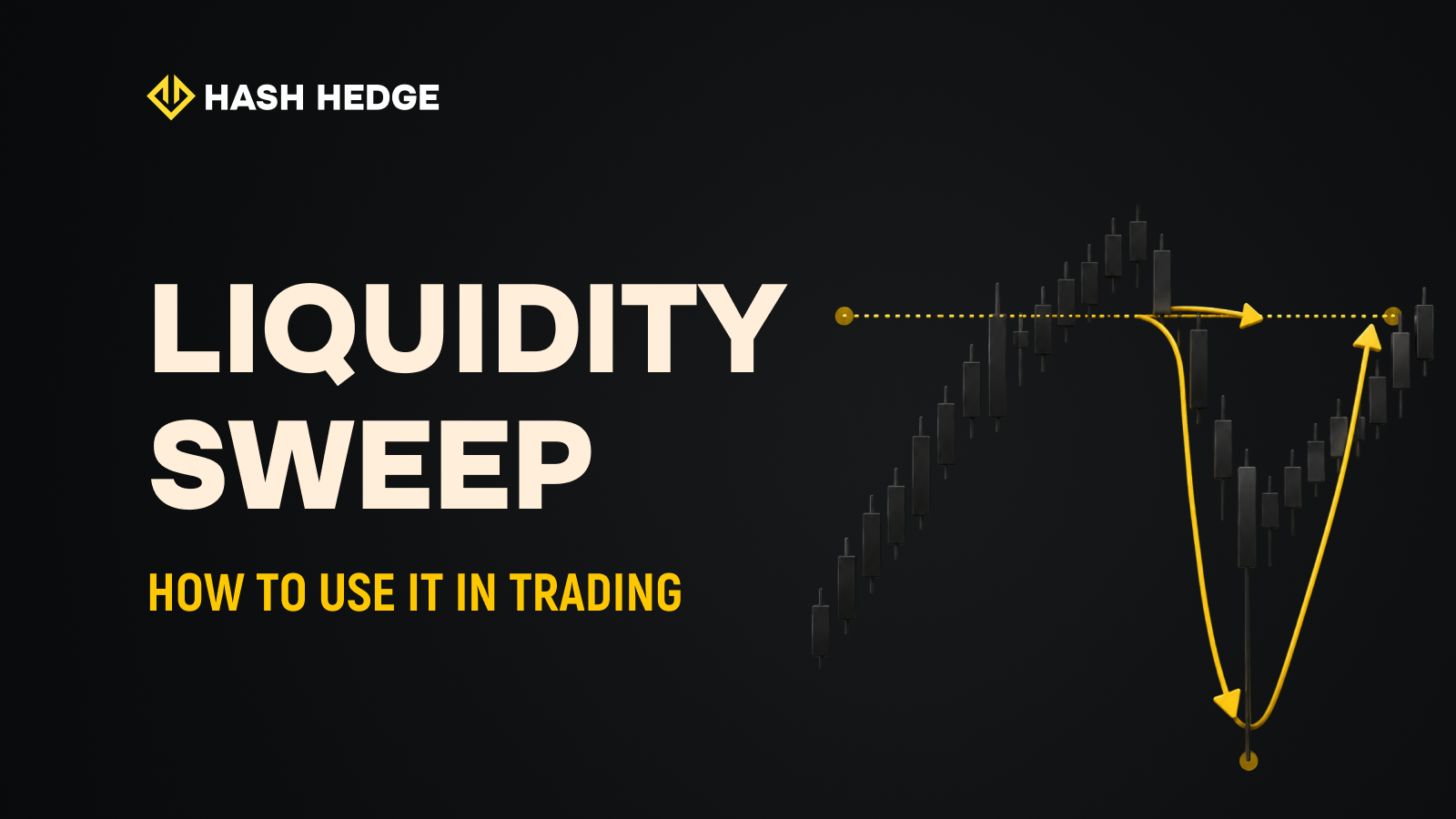
In the English-speaking crypto community, three terms are often used almost interchangeably: liquidity sweep, liquidity grab, and stop hunt. Although they describe similar market behavior, they are not the same thing.
A liquidity sweep occurs when price breaks through an important level, triggers clustered stop-loss orders, and then reverses. A liquidity grab is a broader concept that refers to any price movement toward an area where a large number of orders are concentrated. A stop hunt is a deliberate move toward a specific liquidity zone where most traders have placed their stop-losses.
In this guide, we'll break down how a liquidity sweep works, where it forms, how to identify it on BTC/USDT and ETH/USDT charts, and how to build high-probability trade entries after the sweep.
Table of Contents
1. Liquidity Sweep vs. Liquidity Grab vs. Stop Hunt
2. How Liquidity Sweeps Work
3. Bullish vs. Bearish Liquidity Sweeps
4. How Fair Value Gaps Confirm a Liquidity Sweep
5. How to Trade a Liquidity Sweep
6. Liquidity Sweeps on Altcoins vs. BTC and ETH
7. Trading Liquidity Sweeps on a Prop Firm Account
8. Key Takeaways
Liquidity Sweep vs. Liquidity Grab vs. Stop Hunt
Before trading liquidity sweeps, it's essential to understand exactly what happens in each scenario. Confusing these concepts often leads to poor chart analysis and weak trade execution.
Liquidity Sweep
A Liquidity Sweep occurs when price breaks through a significant level – for example, a series of equal lows on the H4 timeframe – triggers accumulated stop-loss orders, and then reverses sharply in the opposite direction. The breakout itself is real, but the trend fails to continue. Instead, the reversal is confirmed by market structure, often through the formation of a Fair Value Gap (FVG) or a Break of Structure / Market Structure Shift (BOS/MSS).
Liquidity Grab
A Liquidity Grab is much faster and more aggressive. Price spikes beyond a level for only one or two candles before immediately returning. On the chart, it typically appears as a long wick. Liquidity grabs are especially common on high-volatility altcoins and lower intraday timeframes.
Stop Hunt
A Stop Hunt refers to price intentionally moving toward an area where stop-loss orders are concentrated. Unlike a liquidity grab, a stop hunt may develop over a longer period, particularly before major macroeconomic events such as CPI releases or FOMC meetings. Once those stops are triggered, the market frequently reverses.
For a deeper discussion of false breakouts and stop hunts, see our article on False Breakouts vs. Stop Hunts.
Sweep vs. Grab vs. Hunt
Feature
Liquidity Sweep
Liquidity Grab
Stop Hunt
What happens
Price breaks a key level, triggers stop-losses, then reverses
Sharp spike beyond a level followed by an immediate reversal
Price intentionally moves toward a major stop-loss cluster
Speed
Moderate (several candles)
Extremely fast (1–2 candles)
Can develop over a longer period
Typical timeframe
Higher timeframes (H4, D1)
Any timeframe, commonly M15–H1
Usually around major market levels
Confirmation
Fair Value Gap (FVG), BOS/MSS
Pin bar, engulfing candle
Strong reversal accompanied by volume
Crypto examples
BTC/USDT and ETH/USDT on H4–D1
Volatile altcoins
Frequently appears before CPI or FOMC announcements
How Liquidity Sweeps Work
Where Liquidity Pools Form on Crypto Charts
Liquidity naturally accumulates where most traders place their stop-loss orders. These are predictable price areas, including Equal Lows, Equal Highs, Swing Highs, Swing Lows, and frequently tested support and resistance levels.
In Smart Money terminology, these zones are divided into: BSL (Buy-Side Liquidity) – liquidity above the current market price, where short sellers typically place their stop-loss orders; and SSL (Sell-Side Liquidity) – liquidity below the current market price, where long traders' stop-losses are concentrated.
On BTC/USDT, liquidity pools are easiest to identify on the H4 and Daily timeframes. On ETH/USDT, liquidity sweeps occur more frequently and tend to be more aggressive due to Ethereum's relatively higher volatility.
The Three Stages of a Liquidity Sweep
A classic liquidity sweep unfolds in three distinct phases.
Stage 1 – The Breakout. Price approaches a liquidity zone and breaks through it. As the level is breached, clustered stop-loss orders are triggered, causing a temporary increase in trading volume.
Stage 2 – The Reversal. The reversal candle closes back above the broken level (during a bullish sweep) or back below it (during a bearish sweep). This is the key signal that the breakout has failed to hold.
Stage 3 – Displacement. Price moves away from the liquidity zone with strong momentum, often leaving behind a Fair Value Gap (FVG). This displacement is what separates a genuine liquidity sweep from ordinary consolidation around a support or resistance level. If there is no impulsive move after the breakout, the sweep has either not finished – or it wasn't a liquidity sweep at all.
How Long Does a Liquidity Sweep Last?
The duration depends on the timeframe. On the Daily (D1) chart, a liquidity sweep may take anywhere from two to five candles to complete. On the H4 timeframe, the process usually unfolds over several hours or up to a full trading day. On H1 and lower timeframes, sweeps develop much faster but market noise also increases significantly. A practical approach is to identify liquidity zones on H4 or Daily, then switch to H1 or M15 to look for confirmation before entering a trade.
Bullish vs. Bearish Liquidity Sweeps: How to Tell the Difference
Bullish Liquidity Sweep: Price Breaks the Lows and Reverses Higher
A Bullish Liquidity Sweep forms when price moves below a series of lows, triggers the stop-loss orders of long traders (SSL), and then reverses upward. On the BTC/USDT chart, this often appears as a long lower wick on the H4 timeframe, with the candle closing back above the broken support level. Afterward, price accelerates upward with strong momentum. A bullish sweep signals that institutional traders have accumulated long positions by using triggered stop-losses as a source of liquidity.
Bearish Liquidity Sweep: Price Breaks the Highs and Reverses Lower
A Bearish Liquidity Sweep is the mirror image of the bullish setup. Price moves above a series of highs (BSL), triggers buy-stop orders and short sellers' stop-losses, and then reverses downward. On ETH/USDT, bearish liquidity sweeps frequently occur after bullish news events, when retail traders chase a breakout above resistance – to become trapped as price quickly reverses.
How Fair Value Gaps Confirm a Liquidity Sweep
Once a liquidity sweep is complete, the displacement phase often leaves behind a Fair Value Gap (FVG) – an imbalance created between the wicks of three consecutive candles. Markets frequently revisit these imbalances before continuing the new trend.
The appearance of an FVG immediately after a liquidity sweep provides additional confirmation that the move is supported by institutional order flow rather than random volatility. If a sweep is followed by both strong displacement and a clearly defined Fair Value Gap, the probability of a genuine reversal increases significantly.
For a detailed explanation of how to identify and trade Fair Value Gaps, see our dedicated FVG guide.
How to Trade a Liquidity Sweep
Wait Until the Sweep Is Complete Before Entering
The most common mistake traders make is entering as soon as price breaks a key level. At that moment, it's impossible to know whether price is performing a liquidity sweep or simply breaking out to continue the trend. A reversal trade should only be considered after the reversal candle closes back beyond the broken level.
For example, if BTC/USDT sweeps a series of H4 lows, wait for the H4 candle to close back above those lows. Only then should you move to a lower timeframe, such as H1 or M15, to search for an entry setup.
Confirmation Signals: Volume, Wick Size, and Candle Close
Three factors significantly increase the reliability of a liquidity sweep.
Volume. A sharp increase in trading volume during the breakout, followed by lower volume on the reversal candle, suggests that aggressive buyers or sellers have completed their orders. This often indicates that institutional participants have successfully accumulated or distributed positions.
Wick Size. A long wick with the candle closing near its high (for a bullish sweep) or near its low (for a bearish sweep) is one of the strongest confirmation signals. It shows that price was quickly rejected after taking liquidity beyond the key level.
Candle Close. The reversal candle should close decisively back beyond the broken level. Simply touching the level isn't enough. A strong close confirms that the breakout has failed and that market structure is shifting.
Where to Place Your Stop-Loss
A stop-loss should always be placed beyond the extreme of the liquidity sweep. For a bullish sweep, place the stop below the lowest wick. For a bearish sweep, place the stop above the highest wick. This represents the logical invalidation point for the setup. If price returns beyond the sweep extreme and establishes acceptance there, the market structure has changed and the original trade idea is no longer valid.
For a detailed guide on stop placement and risk management when trading liquidity sweeps, see our dedicated article on Risk Management.
Liquidity Sweeps on Altcoins vs. BTC and ETH
On BTC/USDT and ETH/USDT, liquidity sweeps usually follow the classic pattern: clearly defined liquidity levels; sufficient trading volume; clean reversals with strong follow-through. This is largely due to the deep liquidity of these markets. Large institutional traders prefer Bitcoin and Ethereum when building sizable positions.
Lower-cap altcoins behave differently. Liquidity pools are much smaller, making sweeps significantly more aggressive. Price can move 5-10% beyond a level within minutes, only to reverse just as quickly. These markets are harder to trade because: execution is less predictable; slippage is higher; volatility increases dramatically after the sweep.
For this reason, it's generally best to master liquidity sweep trading on BTC/USDT and ETH/USDT first. Once you become comfortable identifying the pattern, you can gradually move to altcoins while reducing your position size to account for the increased volatility.
Trading Liquidity Sweeps on a Prop Firm Account
Why Liquidity Sweeps Are High-Risk Setups During a Challenge
Trading a liquidity sweep means entering against the short-term market impulse. If the sweep has not yet completed, price may continue moving in the breakout direction, causing the position to suffer a significant loss. On a personal account, this is frustrating but manageable. On a prop firm account, however, it can result in violating the daily drawdown limit.
In the Hash Hedge Two-Step Challenge, the daily drawdown limit is 5%, while the maximum overall drawdown is 10%. If you risk 2% of your account on a single trade, one failed liquidity sweep is usually manageable. However, risking 4–5% on what appears to be an "obvious" setup can put your account dangerously close to violating the challenge rules after just one losing trade.
For a detailed explanation of position sizing for high-volatility setups and risk management on funded accounts, see our dedicated guide.
Using Multiple Timeframes to Confirm a Liquidity Sweep
One of the most effective ways to improve trade quality is by applying multi-timeframe analysis. Start by identifying a liquidity pool on a higher timeframe, such as H4 or Daily. Wait for the liquidity sweep to occur. Then switch to a lower timeframe – typically H1 or M15 – and look for confirmation of a market structure shift. For a bullish setup, this may be the formation of the first higher low. For a bearish setup, look for the first lower high. Only after market structure confirms the reversal should you consider entering the trade.
This approach significantly reduces false signals and makes liquidity sweep setups more reliable within the strict risk limits of prop trading.
Key Takeaways
A Liquidity Sweep is a breakout beyond a key price level followed by an immediate reversal, typically driven by institutional order execution. It differs from a Liquidity Grab in both speed and scale, and from a Stop Hunt by the presence of a clear structural confirmation after the breakout.
Liquidity sweeps are generally easier to identify on BTC/USDT and ETH/USDT than on lower-cap altcoins. Bitcoin and Ethereum tend to produce cleaner levels, more reliable volume profiles, and clearer reversals. Smaller-cap cryptocurrencies often experience much more aggressive sweeps, making smaller position sizes essential.
Trade entries should only be taken after the sweep has fully completed. Wait for the reversal candle to close back beyond the broken level before entering. The stop-loss should be placed beyond the sweep extreme. Additional confirmation comes from: the formation of a Fair Value Gap (FVG) during the displacement move; a market structure shift on a lower timeframe.
When trading on a prop firm account, strict position sizing is essential. Even the highest-probability liquidity sweep setup is not worth violating your firm's risk management rules. Successful prop traders prioritize capital preservation first – profits come second.
Ready to trade on prop firm capital?
Hash Hedge is the #1 crypto prop trading platform. Get funded up to $150K and withdraw up to 90% of profits in USDT directly to your wallet.