





←
Hash Hedge Blog
FAILED TWO CHALLENGES BECAUSE OF ONE MISTAKE. WITHDREW $1,409 ON THE THIRD
Blew Two Challenges Because of One Mistake. Withdrew $1,409 on the Third
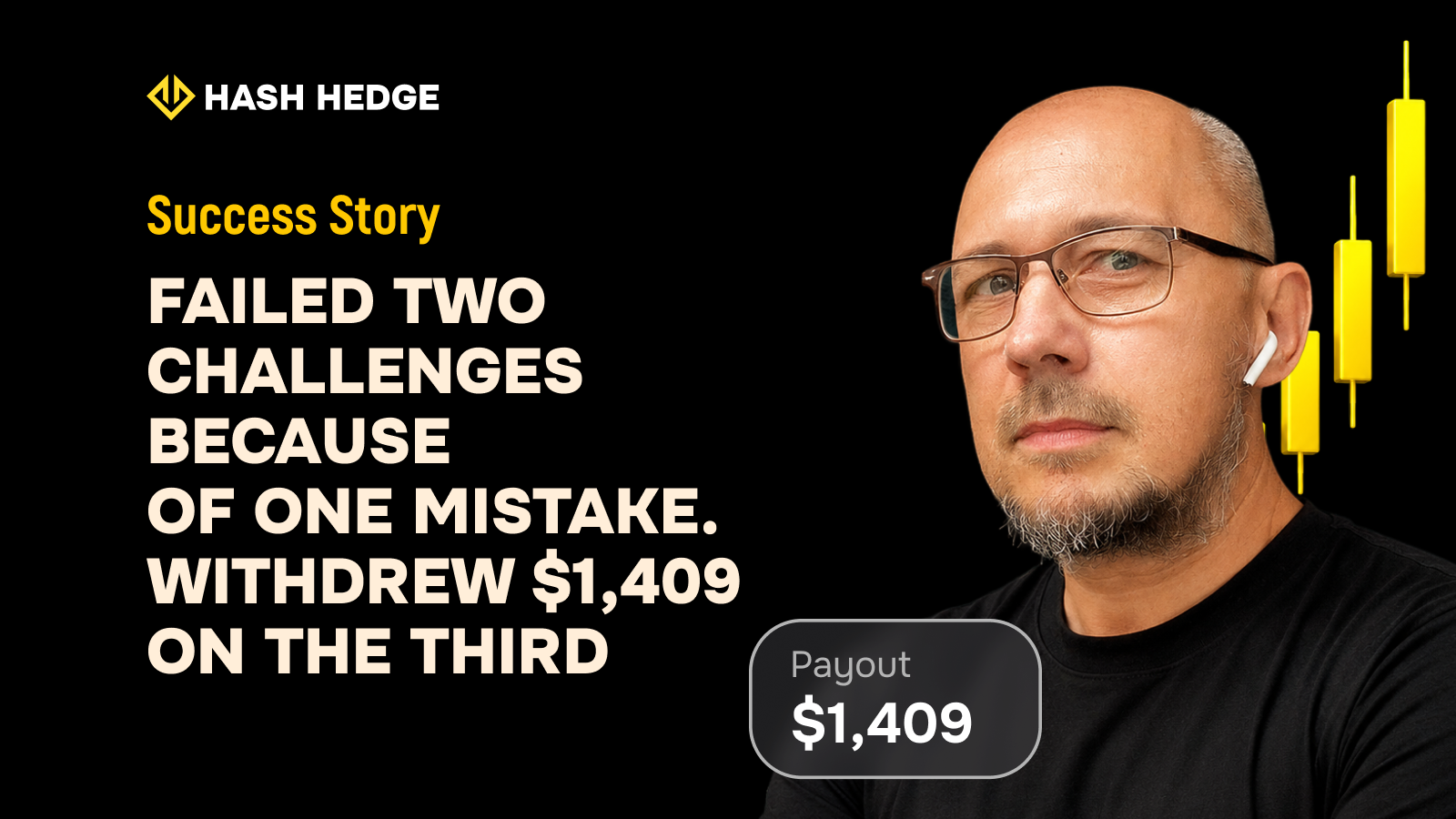
Vladimir has been trading for three years and primarily trades BTC. Over that time, he went through liquidations, several rounds of trading education, and two failed Hash Hedge Challenges. He passed his third Challenge, received a $10,000 Funded Account, and withdrew $1,409. The main mistake remained the same throughout his journey: Vladimir kept moving his stop-loss and holding on to a trade idea for too long, even when the market was already moving against him. Over time, he realized that results depend not only on strategy, but also on the ability to follow your own rules. This is the story of how working on psychology, discipline, and risk management helped Vladimir change his approach to trading and reach his first payout.
Table of Contents
From construction to trading
Signals without stop-losses and the first liquidations
How Vladimir Trades Smart Money
Liquidity, Order Blocks, and FVGs
Not Every FVG Is Worth Trading
90% of his trades are on Bitcoin
Personal record: "27 trades open at once"
Why prop trading changed his approach
One Mistake Cost Him Two Hash Hedge Challenges
Why Vladimir Discussed Stop-Losses With a Psychologist
The third Challenge was almost blown too
What ultimately earned him $1,409
What he spent his first payout on
Rule #1 – You don't have to catch 1:8
Rule #2 – "The best trade is the one you didn't take"
Rule #3 – Losing focus doesn't only happen on the chart
Rule #4 – 90% of trading is psychology
Key takeaways
From Construction to Trading
Vladimir's main business is construction. Working with other contractors was one of the reasons he became interested in trading. In construction, the outcome doesn't depend on you alone. Someone promises to finish a job on time, does something completely different, and Vladimir is the one who has to answer to the client.
"I got tired of being lied to. Tired of being let down, tired of getting screwed over. I wanted something where I wouldn't have to depend on anyone."
That independence was exactly what attracted him to trading.
"It's just you and the market. You don't depend on anyone else."
Money was an important motivator, but according to Vladimir, it wasn't the main reason. He enjoyed digging into things, analyzing them, and figuring out why something happened. He brought the same mindset from construction into trading.
"I like digging into things and figuring them out. I genuinely enjoy it. In trading, I dig into these blocks, FVGs, and so on."
Signals Without Stop-Losses and the First Liquidations
Vladimir's journey didn't start with Smart Money*.
Note: Smart Money is a trading approach based on analyzing the behavior of large market participants through liquidity, price structure, Order Blocks, and FVGs.
At first, he traded signals. He was given an entry and a take-profit target, but there was no stop-loss.
"There was never a stop-loss. That's why there were so many liquidations."
His position size could reach as much as 40% of his deposit. After several liquidations, Vladimir realized he couldn't continue without proper education. His first course didn't immediately solve the problem.
"I was such a beginner that I didn't understand anything at all. They were talking about impulse, correction, impulse – I had no idea what any of it meant."
Later, he continued learning and eventually moved toward the Smart Money approach.
How Vladimir Trades Smart Money
Vladimir explains his strategy simply: "We look for where Smart Money is entering, and that's where I try to enter too."
Vladimir believes the market moves from one pool of liquidity to another. The trader's job is to understand the context of that move and find confirmation for an entry. At the same time, Vladimir tries to keep his charts as clean as possible and barely uses indicators.
His analysis starts on the daily timeframe. There, Vladimir determines the most likely direction of the market. Then he moves down to the 4H and 1H charts, while entries are usually identified on the 5–15 minute timeframes.
"I trade on the 5-minute chart – 5 to 15 minutes for entries. I use the daily timeframe just to see where price is more likely to move."
If the structure points upward, he prioritizes longs. Local shorts are still possible, but Vladimir considers them more aggressive.
Liquidity, Order Blocks, and FVGs
Vladimir's analysis is built around several Smart Money concepts:
liquidity
market structure
Order Blocks
FVGs (Fair Value Gaps)
An FVG by itself is not enough for him to enter a trade. Vladimir looks at the broader context: where the zone formed, how much volume traded within it, what happened to liquidity, and whether there was a break of structure. The last factor is especially important.
"A break of structure is my priority. For me, that's confirmation for an entry."
When a liquidity sweep, a break of structure, and an FVG inversion appear together, Vladimir considers the setup significantly stronger. Price first takes accumulated liquidity, then shifts its local structure, and finally confirms the new direction through an inversion of the imbalance zone.
"If I see a liquidity sweep + break of structure + inversion, that's an absolute killer setup."
Not Every FVG Is Worth Trading
Over time, Vladimir developed his own filters for FVGs.
#1 – Volume
For Bitcoin, he looks for certain minimum volume levels depending on the timeframe. For example, for the BTC FVGs he considers, Vladimir mentions a minimum value of around 500. But he emphasizes that volume alone is still not enough.
"You shouldn't enter based on an FVG alone, because it can get blown through whether the volume is 1,200 or 1,800. You need additional context."
#2 – When the FVG Formed
He is generally more cautious with zones formed overnight or during weekends, and often skips them entirely. The reason is simple: once a trader spots a bullish FVG, they can start looking only for confirmation of their long bias and stop noticing signals pointing in the opposite direction.
#3 – Break of Structure – the Most Important Factor
"An FVG that forms during a break of structure is the most important factor. When you get that, it's a great entry setup."
In other words, Vladimir doesn't trade an FVG as a standalone signal. He breaks down what is happening on lower timeframes and looks for additional confirmation.
90% of His Trades Are on Bitcoin
Bitcoin is Vladimir's main trading asset.
"90% of my trading is BTC."
He may also look at Ethereum, Solana, and other major cryptocurrencies, but his analysis is still centered around BTC. Vladimir also monitors Bitcoin and USDT dominance when the BTC chart alone isn't enough to build a clear scenario. The principle is simple: if the market doesn't make sense, you don't have to trade it.
Personal Record: "27 Trades Open at Once"
Vladimir didn't always follow that principle. When he was trading a small personal deposit, another psychological problem emerged: the profit from a single trade felt too small. If your deposit is $100, making $1 doesn't feel very exciting. So the temptation is to keep opening more positions. At one point, Vladimir had 27 trades open at the same time.
"I had 27 trades open. It's hard to imagine how you can keep track of all of them. Complete loss of focus."
According to Vladimir, he didn't increase the risk per position. A 1% risk remains his main rule, and when necessary, he can reduce it to 0.5%. The problem was the sheer number of positions. Today, his approach is the opposite: fewer assets, fewer trades, and more focus on a specific setup.
Why Prop Trading Changed His Approach
When Vladimir started learning about prop trading, he became interested in the ability to trade larger capital while operating within predefined risk limits. With a small personal deposit, a $1 profit felt insignificant. That pushed him toward opening more trades and holding positions for longer. On a $10,000 prop account, the same percentage return translated into a very different dollar amount, removing the need to constantly chase more trades.
The strict limits helped too. They prevented losses from growing indefinitely and forced him to take his stop-loss more seriously.
"Prop trading helped me a lot. I'm really grateful that the rules are so strict."
For Vladimir, those restrictions weren't an obstacle. They became a framework that helped him control both his risk and his own behavior.
One Mistake Cost Him Two Hash Hedge Challenges
Vladimir failed his first two Hash Hedge Challenges.
First $10K account – failed at Stage 1
Second $10K account – failed at Stage 2
The reason was the same both times:
"I have a big problem – I moved my stop-loss."
Before entering a trade, Vladimir already knew exactly how much he was willing to lose. But when price approached his stop, accepting the loss became difficult, so he gave the trade more room.
"I was afraid of losing $100, but I could end up losing $500."
Why Vladimir Discussed Stop-Losses With a Psychologist
The stop-loss issue kept repeating so often that Vladimir decided to dig deeper and even discussed it with a psychologist.
"I needed to figure out where this thing was coming from and get it out of the way."
Whenever price approached his stop-loss, Vladimir felt the urge to give the position just a little more room. At that moment, he was convinced the market was about to reverse. That's how a predefined $100 loss could gradually turn into $500.
His attitude is different now.
"I set the stop-loss. That's it. Stop."
One important turning point came when Vladimir got stopped out of a trade that fully matched his system – and calmly accepted it. Price eventually moved in the direction he had expected, but that didn't mean the entry or the stop was wrong. For him, this reinforced another important idea: if a trade was taken according to the rules, one stop-out doesn't mean you need to change your system or interfere with the position.
The Third Challenge Was Almost Blown Too
For his next attempt, Vladimir chose another $10K account. This time, he started following his own rules more strictly. The problem wasn't his strategy. He already knew how to analyze the market and find entries. The real difficulty started after entering a trade, when emotions began influencing his decisions. Because of that, his third Challenge almost ended in failure too. At one point, the account was down around $900 – close to a 9% drawdown. According to Vladimir, there was almost no room left for another mistake.
That was when he stopped.
"I accepted it: okay, stop. Enough. I pulled myself together."
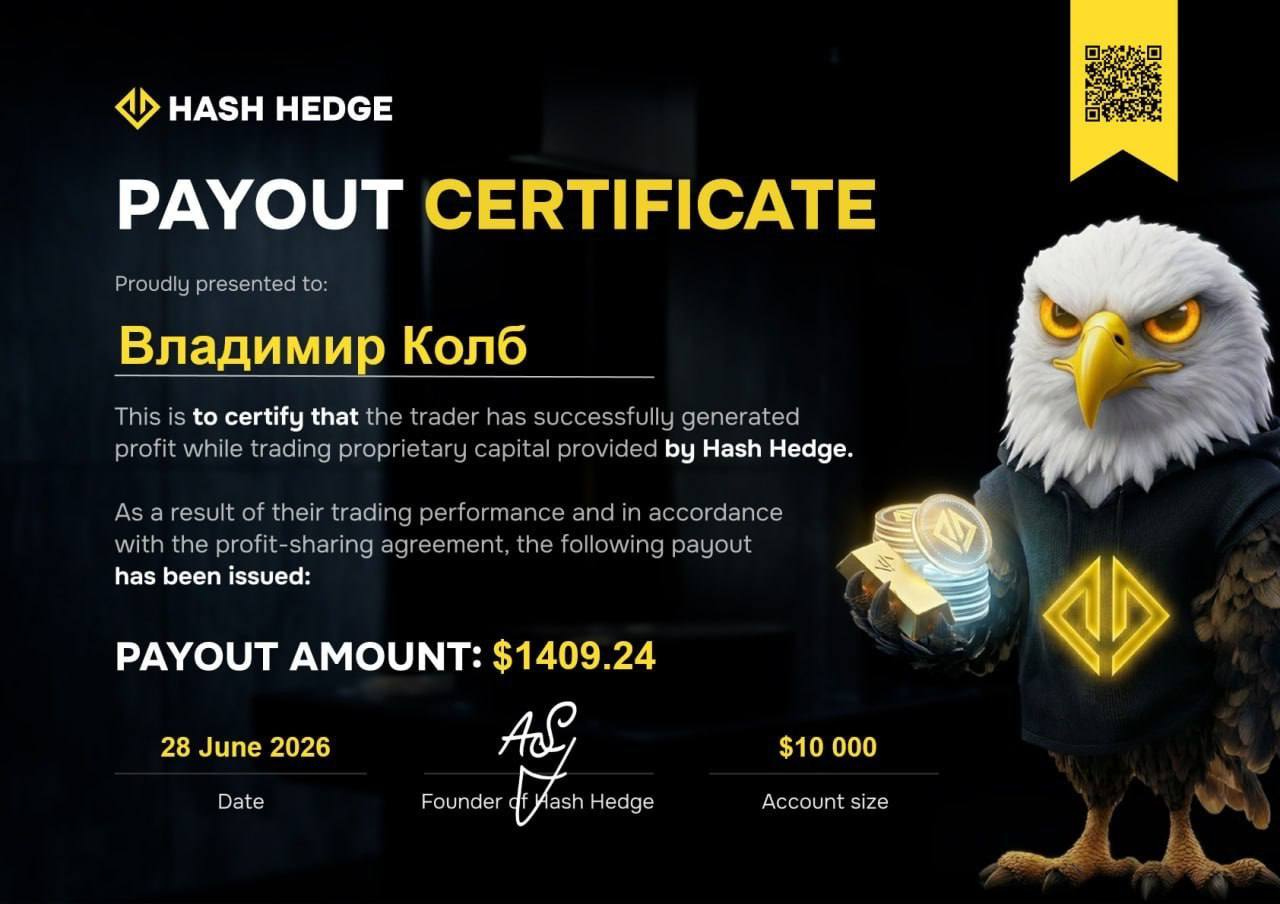
After that, Vladimir stopped interfering with predefined stops and began consistently trading according to his rules. He recovered the account from drawdown, passed Stage 1, then Stage 2, received a $10,000 Funded Account, and later got his first $1,409 payout.
What Ultimately Earned Him $1,409
When asked: "What got you the payout – Smart Money or your ability to follow your own strategy?" Vladimir answered:
"Psychology helped more."
By that point, Vladimir already understood liquidity, structure, Order Blocks, and FVGs. But knowledge alone wasn't enough. The real change came when he started following his own rules: not moving his stop-loss, taking profit where the setup called for it, not chasing massive RR, and staying out of the market when the situation wasn't clear.
"Set the stop. The position gets stopped out – no big deal. Do your analysis and move on."
That's how a third attempt that was once nearly 9% in drawdown ultimately turned into a passed Challenge, a Funded Account, and a $1,409 payout.
What He Spent His First Payout On
When Vladimir received his first payout, he decided that part of the money had to be spent on himself. So he bought a watch.
"I told myself, 'Congratulations, first payout.' I needed to actually feel it, hold onto that moment, buy something so I'd have something tangible from it."
The choice was symbolic. Vladimir likes control and schedules and says that even in everyday life, he tends to do things according to a set time. But the bigger point was the reward itself. For him, a goal should end with a tangible result. If you set a goal to earn enough for a watch, then once you hit that goal, you should actually buy the watch instead of backing out because you suddenly don't want to spend the money.
"If you set a goal to buy a watch, buy the watch. Don't get stingy."
Now the watch represents more than just $1,409. It reminds him of his first payout after years of trading, liquidations, and failed Challenges.
Rule #1 – You Don't Have to Catch 1:8
Over three years of trading, Vladimir developed several rules that help him interfere less with his trades, stop chasing every move, and stay focused. Many of them came directly from his own mistakes, liquidations, and failed Challenges.
The main objective is to take a clear, reasonable profit – not hold a position just to achieve the most impressive risk-to-reward ratio possible. When his deposit was small, Vladimir wanted every winning trade to catch a huge move. That's no longer the goal.
At the first significant zone, he may take 25-50% off the position. If he sees a potential reversal, he is willing to close the trade even with a relatively modest risk-to-reward ratio. The biggest move he says he has ever held was around 6R.
"I took my profit. What happens next is unknown."
He doesn't care if price keeps moving after he exits and could theoretically have delivered 8R.
"My job is to come to the market, make money, and take that money – not just sit there watching price fly somewhere."
Rule #2 – "The Best Trade Is the One You Didn't Take"
If the market doesn't offer a clear scenario, Vladimir prefers to skip the entry and preserve his capital.
During the interview, Vladimir showed a setup he had intentionally skipped the day before. He could see arguments for both longs and shorts but couldn't confidently put them together into one clear scenario. So he stayed out. Looking back at the move the next day, Vladimir could see confirmations that might have justified an entry. But he doesn't consider the missed profit a mistake.
"Sometimes the best trade is the one you didn't take. The most important thing is that you protected your capital."
For him, not taking a trade is still a trading decision. If the market is unclear, sometimes the best move is to wait. There will always be another opportunity.
Rule #3 – Losing Focus Doesn't Only Happen on the Chart
When Vladimir trades, he tries to remove anything that could affect his decisions: messages, other tasks, and other people's analysis. Everything happening around your trading can affect the quality of your decisions. He avoids combining market analysis with unrelated activities.
"If you're trading, then trade. If you're taking out the trash, take out the trash. If you're driving, then drive."
Messages, conversations, and other tasks create distractions while searching for an entry. The same applies to other traders' analysis. In the past, Vladimir would check several channels after completing his own analysis. If his setup was bearish but another trader was calling for a long, he would start doubting himself. As a result, Vladimir reduced the amount of outside analysis he consumes while trading.
"I do my own analysis – purely my own – and that's it."
Rule #4 – 90% of Trading Is Psychology
According to Vladimir, even a strong strategy won't help if a trader can't control their emotions and follow their own rules.
"Trading is 90% psychology."
He says the market forces you to confront behavioral patterns you might not even notice outside trading.
"It'll pull out skeletons you didn't even know you had."
Your decisions can also be affected by what is happening away from the terminal: problems at home, stress at work, fatigue, or frustration. In those situations, Vladimir believes the right decision may be not to trade at all. If your mind is occupied with something else, following your system properly becomes much harder.
Key Takeaways
1
A strategy without discipline doesn't solve the problem
Vladimir already understood Smart Money and knew how to find setups before passing his Challenge. He failed his first two Challenges because he kept moving his stop-loss.
2
An FVG is not a standalone signal
Vladimir looks at volume, liquidity, higher-timeframe context, and market structure. He considers an FVG formed during a break of structure one of the strongest confirmations.
3
Not taking a trade is still a trading decision
If Vladimir doesn't understand what the market is doing, he is willing to sit out the move. Preserving capital matters more to him than potential profit.
4
A small deposit pushed Vladimir to compensate with quantity
At one point, he had 27 positions open simultaneously. Over time, he realized this only created more distraction. A larger prop account allowed him to stop chasing trade quantity and focus more on entry quality.
5
A stop-loss should invalidate the idea, not become a negotiation
Vladimir's biggest recurring mistake was moving his stop-loss. Fixing that behavior became one of the most important parts of his development as a trader.
6
The goal is to make money, not maximize RR at all costs
Vladimir doesn't try to squeeze every possible dollar out of every trade. He may take partial profit at the first significant zone and is comfortable watching price continue moving after he exits.
Ready to Trade with Prop Firm Capital?
Hash Hedge is a prop trading platform for trading RWAs and cryptocurrencies 24/7. Get funded with up to $150,000 and withdraw up to 90% of your profits in USDT directly to your wallet.
Read Also
Made 20x in Prop Trading: $99 → $2,000
From Selling Gravel and Repairing Old Ladas to Managing a FUNDED Account