





←
Hash Hedge Blog
PRICE IMBALANCE: WHAT AN IMPULSE LEAVES BEHIND AND HOW TO TRADE IT
What Is Fair Value Gap (FVG) in Crypto Trading and How to Use It
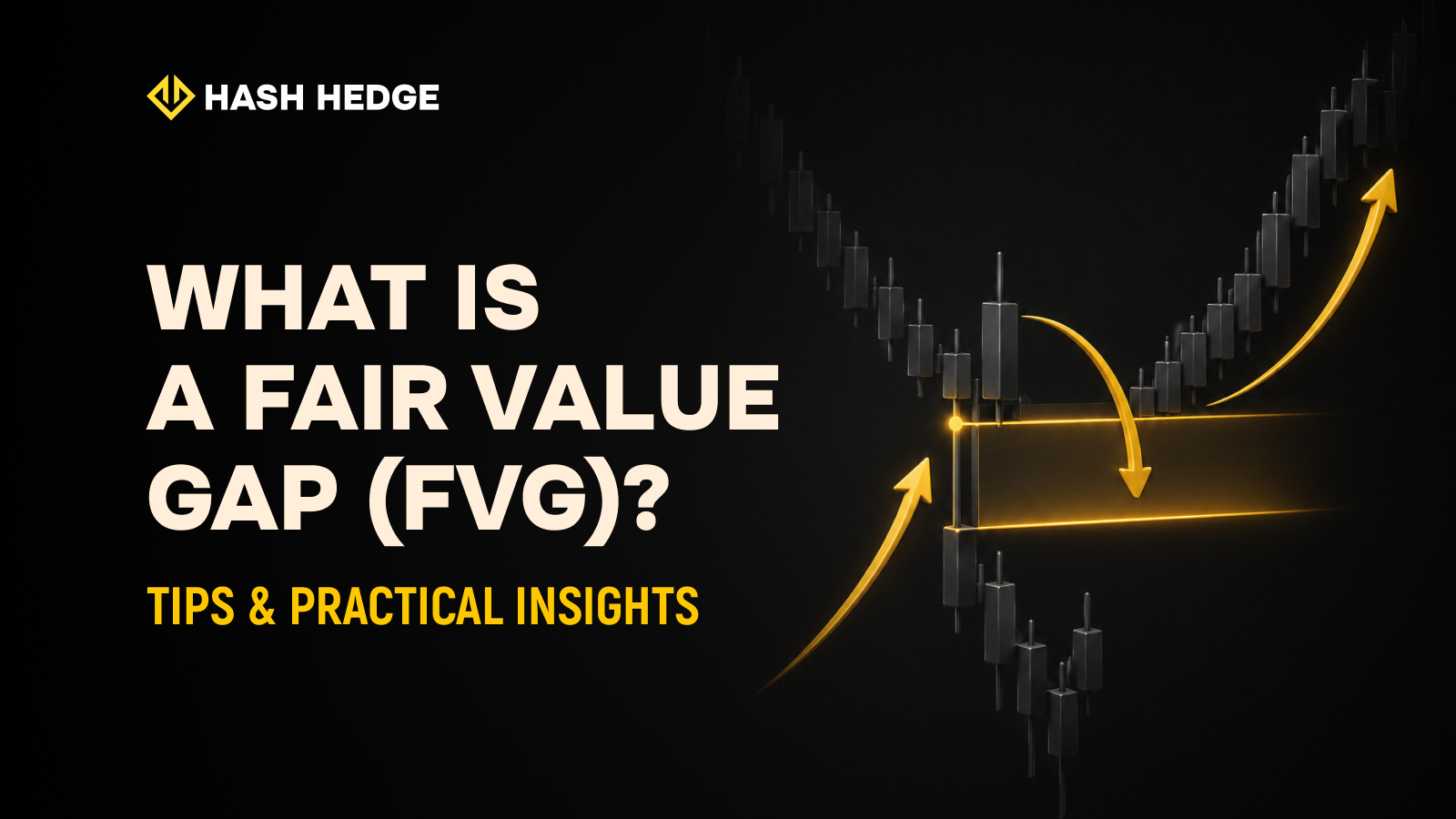
Table of Contents
What Is a Fair Value Gap?
How to Identify a Fair Value Gap
Which Timeframes Work Best for FVG on BTC and ETH?
Why Does Price Return to Fill a Fair Value Gap?
How to Trade a Fair Value Gap
Combining FVG with Market Structure
Fair Value Gaps and False Breakouts
Trading Fair Value Gaps on a Prop Trading Account
Key Takeaways
FAQ
What Is a Fair Value Gap?
The term Fair Value Gap (FVG) appears in almost every Smart Money Concept (SMC) or ICT trading video. However, most explanations are based on Forex examples using EUR/USD. In crypto, the mechanics are the same, but the details matter. BTC and ETH behave differently from traditional currency pairs, and understanding these differences can significantly improve your trading decisions.
In this guide, we'll explain what a Fair Value Gap really is, how the three-candle formation appears on BTC/USDT charts, why price tends to return to fill the gap, and how to build an FVG trading strategy while staying within proper risk management rules.
A Fair Value Gap is not a traditional chart pattern. Instead, it represents a price imbalance — an area where price moved so quickly that very few trades were executed between buyers and sellers. Because markets naturally seek efficiency, price often revisits these zones to "fill the gap," allowing previously skipped orders to be executed.
This is why an FVG is much more than a visual pattern that "works because everyone watches it." It reflects the underlying mechanics of order execution. An imbalanced move creates an inefficient pricing area that often attracts price back with a relatively high probability.
In practice, FVGs usually appear after strong impulsive moves, including: liquidity sweeps, major news releases, rapid breakouts, and low-liquidity periods such as weekends or the Asian trading session.
How to Identify a Fair Value Gap
An FVG is identified using three consecutive candles, with the middle candle being the impulsive move.
Bullish Fair Value Gap: Low of Candle 3 > High of Candle 1. The space between the High of Candle 1 and the Low of Candle 3 becomes the Fair Value Gap.
Bearish Fair Value Gap: High of Candle 3 < Low of Candle 1. The gap between the Low of Candle 1 and the High of Candle 3 becomes the bearish Fair Value Gap.
Candle
Description
Price
Candle 1
Bullish
High = 67,200
Candle 2
Impulsive
Strong expansion
Candle 3
Bullish
Low = 68,400
The price zone between 67,200 and 68,400 is the bullish Fair Value Gap. During the next correction, price often revisits this area before continuing higher.
A bullish Fair Value Gap forms during an upward impulse. The middle candle is a large bullish expansion candle, leaving an imbalance below it. When price later pulls back into that gap, traders watch for buying opportunities.
A bearish Fair Value Gap works the opposite way. It forms during a strong downward move. The impulsive candle is bearish, leaving an imbalance above it. When price rallies back into the gap, it becomes a potential short-entry zone.
One important note for crypto traders: not all FVGs carry the same weight. An FVG that forms after a liquidity sweep on the H4 timeframe is generally far more significant than an FVG created randomly on an M5 chart.
Which Timeframes Work Best for FVG on BTC and ETH?
For BTC/USDT, the highest-quality Fair Value Gaps typically appear on the H4 and Daily charts. These higher timeframes usually represent genuine institutional order flow, making the probability of a price revisit much higher.
For ETH/USDT, both H1 and H4 produce reliable FVG zones. While FVGs also exist on M15 and lower timeframes, the amount of market noise increases significantly, reducing signal quality.
A practical workflow: identify the Fair Value Gap on H4 or Daily, wait for price to return, then refine your entry on H1 or M15. This multi-timeframe approach offers a much better balance between precision and reliability.
Why Does Price Return to Fill a Fair Value Gap?
The market is, at its core, a system of orders. An impulsive move occurs when one side of the market suddenly overwhelms the other with aggressive buying or selling. As a result, price moves so quickly that many orders remain unfilled within a certain price range. Market makers and algorithmic trading systems often drive price back into these areas to execute the remaining orders. This isn't market "magic" — it's simply how order execution works.
When Do Fair Value Gaps Get Filled? Most Fair Value Gaps are eventually filled, but not all of them. During a strong daily trend, an H4 FVG can remain untouched for days or even weeks. Gaps formed after major structural events — such as breaking a multi-month resistance level or reacting to significant macroeconomic news — are generally filled less frequently and may take much longer to revisit. A practical rule: an H4 Fair Value Gap formed during a range or a corrective move has a much higher probability of being filled than an H4 FVG created during the early stages of a powerful new trend.
Partial Fill vs. Full Fill. Price does not have to trade through the entire Fair Value Gap. In many cases, simply touching the upper or lower boundary of the zone is enough before the trend resumes. This is known as a partial fill. A full fill occurs when price trades through the entire imbalance and closes beyond the opposite side of the gap. For trading purposes, the beginning of the fill is usually the most important — that is where traders look for entries. The objective is not necessarily for price to completely fill the gap, but rather to identify a high-probability continuation point near the start of the imbalance.
How to Trade a Fair Value Gap
Wait for Price to Return Before Entering. One of the most common mistakes is buying immediately after an FVG forms, simply following the impulsive move. A better approach is to wait for price to retrace into the Fair Value Gap before considering an entry. For example: if BTC/USDT forms a bullish FVG after breaking resistance, wait for price to pull back into the imbalance. Once price enters the gap, look for confirmation that buyers are stepping back in before opening a long position. This approach dramatically improves the risk-to-reward ratio because entries occur closer to the invalidation level while maintaining a larger upside target.
Where Should You Place Your Stop Loss? For a bullish setup, the stop loss should be placed below the Fair Value Gap. For a bearish setup, the stop belongs above the Fair Value Gap. The logic is straightforward: if price trades completely through the imbalance and closes beyond it, the Fair Value Gap has failed as a support or resistance zone. At that point, the setup is invalid, and the trade should be closed according to your trading plan.
(For a detailed explanation of position sizing and stop-loss placement when trading FVGs, see our dedicated risk management guide.)
Combining FVG with Market Structure
Fair Value Gaps become significantly more reliable when combined with market structure. A bullish FVG that forms above the previous Higher High (HH) carries much more weight than one located in the middle of a trading range. Likewise, a bearish FVG that forms below the previous Lower Low (LL) provides stronger confirmation of a continuing downtrend.
This is especially true on ETH/USDT during strong trending markets. A sequence of bullish FVGs forming progressively higher — or bearish FVGs forming progressively lower — is often a sign of sustained institutional buying or selling pressure. Understanding the relationship between Fair Value Gaps and market structure helps traders distinguish between high-quality setups and ordinary market noise.
Fair Value Gaps and False Breakouts
Fair Value Gaps are closely connected to false breakouts. When price performs a liquidity grab or a liquidity sweep and then reverses, that reversal almost always leaves a Fair Value Gap behind. This explains why false breakouts and liquidity grabs frequently create FVGs — they are one of the core building blocks of Smart Money analysis.
Why Liquidity Grabs Often Leave Behind an FVG. A liquidity grab is a fast, aggressive move. When price quickly spikes beyond a key level for one or two candles before reversing, the impulsive reversal candle almost always creates a Fair Value Gap. This imbalance is evidence of institutional order accumulation. Large market participants use retail breakout traders as liquidity to build their own positions. On BTC/USDT, this is easy to observe. After a major liquidity sweep on the H4 chart, the reversal impulse often leaves an H1 Fair Value Gap. Price frequently revisits this imbalance before continuing in the new direction.
Using FVG as Confirmation After a Stop Hunt. A classic Smart Money sequence: a liquidity sweep removes clustered stop-loss orders; the reversal creates a Fair Value Gap; price moves away from the sweep; price retraces into the Fair Value Gap for a retest; the trend resumes. Entering on this retest is considered one of the highest-probability setups in Smart Money methodology. A high-quality setup follows one simple rule: in a bullish setup, the Fair Value Gap should form above the liquidity sweep; in a bearish setup, it should form below. This confirms that institutional buying or selling has already entered the market.
Trading Fair Value Gaps on a Prop Trading Account
Why FVG Entries Are Better Suited to Prop Firms Than Breakout Trading. Trading directly from a Fair Value Gap usually involves either a limit order or an entry after a controlled pullback. Unlike chasing breakout candles, an FVG setup provides: a clearly defined entry, a logical stop-loss, and a measurable profit target. These characteristics make Fair Value Gap strategies much more compatible with the strict risk management rules used by prop firms.
In the Hash Hedge two-phase challenge, traders receive a 90/10 profit split in their favor after reaching the funded stage. Consistent execution with clearly defined trading rules offers a much greater edge than randomly chasing momentum. Ultimately, disciplined risk management — not aggressive entries — is what determines whether a trader successfully passes a prop challenge.
What to Do When an FVG Forms Near Your Daily Drawdown Limit. Suppose you're approaching the end of the trading day and your drawdown has already reached 3–4%, while your daily loss limit is 5%. A perfect-looking Fair Value Gap appears on the chart. The correct decision is not to take the trade. Position size should always be determined before entering a trade, based on your predefined risk per trade. If the remaining buffer before your daily drawdown limit is smaller than your planned trade risk, simply skip the setup. The Fair Value Gap isn't going anywhere. If the imbalance remains unfilled by the next trading session, the setup may still be valid tomorrow. Professional traders protect their capital first — and look for opportunities second.
Key Takeaways
A Fair Value Gap (FVG) is a price imbalance formed between the High of the first candle and the Low of the third candle (bullish FVG), or between the Low of the first candle and the High of the third candle (bearish FVG). Markets naturally tend to revisit these inefficient pricing areas.
The highest-quality FVGs in crypto typically form after a liquidity sweep or liquidity grab. These imbalances carry structural significance because they reveal where institutional participants accumulated positions.
To trade FVGs effectively, combine them with market structure: determine the overall trend on a higher timeframe, identify Fair Value Gaps on H4 or H1, and look for entries on a lower timeframe as price retraces into the imbalance. This multi-timeframe approach significantly improves trade quality.
On a prop trading account, Fair Value Gap entries offer clearly defined entry points, logical stop-loss placement, and consistent position management. Most importantly, never increase your position size simply because a setup looks exceptionally good. Risk management rules should remain the same for every trade. Consistency — not confidence — is what allows traders to survive prop firm evaluations and build long-term profitability.
FAQ
What is a Fair Value Gap in simple terms?
A Fair Value Gap is an area on the chart where price moved too quickly, leaving very few executed orders between buyers and sellers. The market tends to return to this zone to "close" the imbalance. It is identified using three candles: if there is a gap between the high of the first candle and the low of the third — that is a bullish FVG; if between the low of the first and the high of the third — that is a bearish FVG.
Do all Fair Value Gaps get filled?
Most do, but not all. A strong D1 trend can leave H4 FVGs untouched for weeks. Gaps formed after major structural breakouts or significant macro events are filled less frequently. A practical rule: an FVG formed inside a range or correction has a much higher probability of being filled than one created at the beginning of a powerful new trend.
Which timeframes are best for trading FVGs?
The optimal approach: identify FVGs on H4 or Daily, where genuine institutional flow is behind the impulse, then look for an entry on H1 or M15. This reduces false signals and provides a logical stop-loss location. FVGs on M15 and lower exist, but the signal-to-noise ratio is significantly worse.
How is an FVG related to false breakouts?
Directly. When price performs a liquidity grab or sweep and reverses, the reversal candle almost always leaves a Fair Value Gap behind. This is a trace of institutional position building. That is why the "false breakout → FVG → retest" sequence is considered one of the highest-probability entry setups in Smart Money methodology.
Can FVG strategies be used in a prop firm challenge?
Yes, and FVG setups are particularly well-suited for prop trading: there is a clear entry point, a logical stop, and a measurable target. Unlike chasing breakouts, FVG entries do not require "guessing" the impulse. The main rule: never enter if the remaining buffer before your daily drawdown limit is smaller than the planned trade risk.
Ready to trade with prop firm capital?
Hash Hedge is the #1 crypto prop trading platform. Get funded up to $150,000 and withdraw up to 90% of your profits in USDT directly to your wallet.