





←
Hash Hedge Blog
HOW TO PASS A PROP CHALLENGE: INSIGHTS FROM TRADING MENTOR ANYA
How to Pass a Prop Challenge: Insights from Trading Mentor Anya
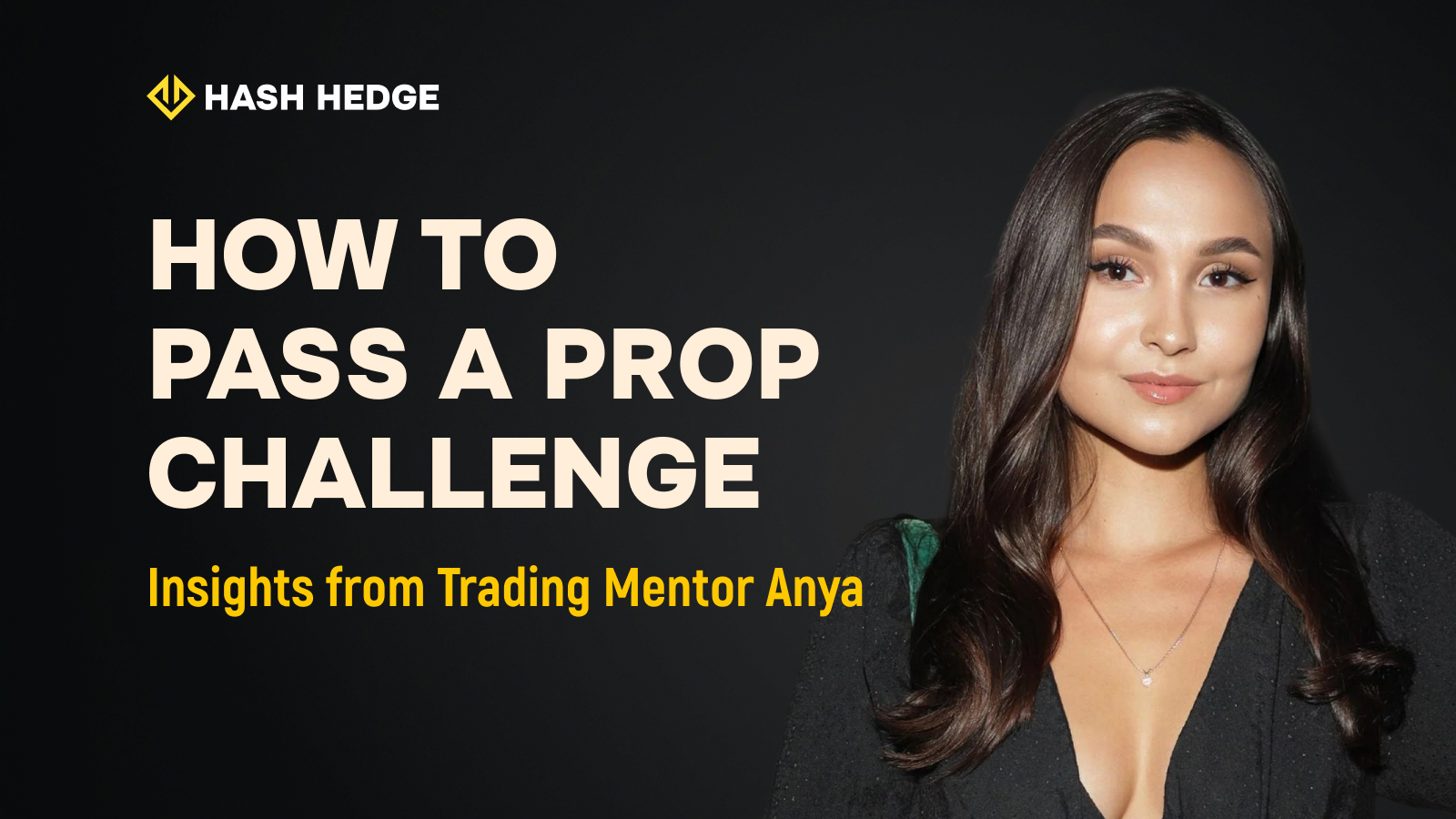
Anya has been trading for five years, and for the past three years she has been teaching other traders and helping them pass prop Challenges.
During that time, she has noticed one recurring pattern: traders often fail not because they have a bad strategy, but because of risk, discipline, and their behavior while trading.
Why does one trader pass a Challenge while another loses account after account? How can you tell before even starting that someone is probably not ready for prop trading? And how much time and money should you realistically set aside for your first attempts?
In this article, we've collected the key insights from our conversation with Anya: the mistakes that most often prevent traders from passing a Challenge, how to build proper risk management, and why sometimes the best trade is the one you decide not to take.
Table of Contents
1. How to Tell If a Beginner Is Likely to Fail a Challenge
2. Overconfidence and Fear Are Equally Dangerous
3. Men and Women: Is There a Difference in Trading?
4. Why It Can Be Better to Practice with a Prop Firm Than with Your Own Money
5. How to Calculate Risk When You Have Multiple Open Positions
6. How Many Trades per Day Is Normal?
7. What to Do When You're in Drawdown – and When You're in Profit
8. How Anya Uses Fibonacci Levels
9. What Account Size to Start With and How Much Time to Allow
10. Patience and Taking Time Away from the Market
Key Takeaways
1. How to Tell If a Beginner Is Likely to Fail a Challenge
According to Anya, you can often spot a problematic trader from the very first questions they ask.
"Most of the time, these are people who want to make money quickly, take huge risks, and completely ignore risk management. Their first question is: how quickly can I make my first million? Can I go all-in with my entire deposit?"
That's why working with a beginner starts not with a complex strategy, but with the basics: risk management, discipline, and the right attitude toward results.
Anya notes that many failures happen because of emotions. A trader wants to pass the Challenge as quickly as possible, starts increasing their risk, and begins treating every trade as an opportunity to make a huge leap toward the target.
"It's important to get rid of the idea that trading is fast money. Don't think you'll pass a Challenge in five days. Trading is work."
The main warning sign here is not the absence of a strategy, but the expectation of quick results.
If a trader starts by thinking about how much they can make in a few days rather than how much they are prepared to lose on a single trade, the probability of breaking the Challenge rules increases significantly.
2. Overconfidence and Fear Are Equally Dangerous
According to Anya, self-confidence is important, but too much confidence can quickly become a problem.
When traders start believing they already understand everything and can pass the Challenge without much difficulty, they are more likely to break their own rules and underestimate risk.
"When you believe in yourself too much and think, 'Everything is great, I'm going to pass this prop Challenge really quickly,' the market punishes people who are overconfident."
But the opposite extreme can be just as damaging. If a trader is afraid of every trade, they start skipping even valid entries and stop following their own system.
When asked who poses a greater risk to themselves – an overconfident trader or someone who is afraid of every entry – Anya chooses the latter.
"Someone who is afraid of every trade will simply never enter positions. Trading just isn't for everyone, and that's okay."
Ultimately, the problem is the same in both cases: decisions are driven by emotions rather than the trading plan.
In one case, the trader risks too much. In the other, they stop taking action altogether.
3. Men and Women: Is There a Difference in Trading?
Most of Anya's students are women. Based on her observations, they tend to approach trades more cautiously and think through the risk in advance more often.
"Girls will analyze every trade: should I enter, where should the Stop Loss be, where should the Take Profit be? Guys often enter immediately, even before reaching the trading module, put in large amounts, and then come back saying: 'Anya, I had $2,000 and now I have $1,300.'"
At the same time, according to Anya, the desire to prove the market wrong can affect anyone. The difference is more about attitudes toward risk.
Based on her observations, men are more likely to choose highly volatile assets and accept greater risk in exchange for potentially higher returns.
"Men tend to choose riskier assets. If a coin can go up 1,000% and fall just as quickly, that's difficult for me – I trade based on fundamentals."
This is not a universal rule, but Anya's personal observation based on her students.
The main takeaway remains the same: results depend much more on how consistently a trader follows risk management and their own trading plan than on gender.
4. Why It Can Be Better to Practice with a Prop Firm Than with Your Own Money
Anya believes prop trading can help many beginners develop discipline faster.
When there are clearly defined risk limits, it becomes harder to justify trades with excessive leverage or oversized positions.
"As soon as I started trading with a prop firm, I began following risk management properly and stopped gambling. When money is just sitting on an exchange, you know you can open a trade with x50 leverage. With a prop firm, you clearly understand that you can only lose 5% per day, so you stop taking those kinds of risky trades."
In her view, the economics of getting started also matter. Instead of immediately risking a large amount of personal capital, a beginner can start with a Challenge and learn to trade within predefined limits.
However, prop trading itself does not solve a discipline problem. If a trader continues taking excessive risk and breaking the rules, those limits will simply expose the problem faster.
5. How to Calculate Risk When You Have Multiple Open Positions
One common mistake, according to Anya, is not trading without Stop Losses, but failing to calculate the combined risk across all open positions.
"If you have five positions open and the Stop Loss on each one is minus $100, while the account is $10,000, then if all five hit their stops at the same time, you lose $500 in one day and use up your entire daily drawdown limit. This is the second most common mistake: the stops are there, but there are too many trades or the Stop Loss is too large."
Before opening another position, it is therefore important to look not only at the risk of that specific trade, but also at how much you could lose across all your open positions combined.
Just because every position looks safe individually does not mean the entire portfolio is safe.
6. How Many Trades per Day Is Normal?
Anya does not set a strict universal limit. On one day, there may be only one high-quality opportunity; on another, there may be several.
"There's no fixed limit. But you still need to avoid overtrading – opening anything just for the sake of opening a trade."
The key metric is not the number of trades, but their quality. If a trader starts entering without a complete setup simply because they want to be in the market, that is already a sign of overtrading.
If the urge to trade is strong but there is no good entry, Anya recommends reducing risk and not trying to force a trade out of the market at any cost.
The principle is simple: the market does not have to provide a good opportunity every day, and not taking a trade can also be the right trading decision.
7. What to Do When You're in Drawdown – and When You're in Profit
A drawdown itself is not a reason to change your trading plan. If the account is down, for example, 2% on the first day, Anya recommends evaluating your emotional state rather than focusing only on the number on the balance.
"If you start feeling emotionally tense, really upset, or everything is irritating you, then yes, take a break. We don't trade when we're in a bad mood."
If emotions are under control, you can continue following the same system with the same risk management.
The same applies to making a quick profit.
A strong start does not mean you should suddenly change your position size or try to preserve your gains at any cost.
"I would continue with the same risk. It's important to understand that there may be a small pullback, and that's normal. If we go into drawdown, it doesn't mean there's something wrong with you. Markets are about probabilities – you can't have only profitable positions."
Anya's main point is not to adjust your trading to every change in P&L.
Individual winning and losing trades remain part of the statistics, so maintaining the same process matters more.
8. How Anya Uses Fibonacci Levels
One of the tools Anya uses in her trading is Fibonacci levels. She draws the Fibonacci retracement over a completed impulsive move and looks for areas where price may stop correcting.
She pays particular attention to the 0.5–0.618 zone, and during deeper corrections, to 0.786.
"Most often, price reaches the 0.5–0.618 zone, and sometimes the deeper 0.786 level. From there, you can start building a position. I've had trades where my Take Profit was between 0.618 and 0.786, and the price reached it almost perfectly."
However, Fibonacci levels alone are not a reason for her to enter a trade. First, she waits for the impulse to finish and evaluates the broader context.
"If we understand that the coin still has room to move – for example, there's an imbalance ahead – it's too early to draw the Fibonacci levels. It's better to wait until the move is complete."
When asked why price reacts to these particular levels, Anya does not try to find a complicated explanation.
"I don't know why. It just works. Maybe it's because a huge number of traders are watching the same levels."
In her approach, Fibonacci is therefore an additional reference point for identifying a potential entry zone rather than a standalone trading signal.
9. What Account Size to Start With and How Much Time to Allow
Anya recommends that beginners start with a $10,000 Challenge rather than the smallest account size.
Based on her observations, a smaller account can sometimes create a false sense that it is okay to take more aggressive risks.
"With a $5,000 account, people tend to take risk less seriously: '10% of the position is only $500, whatever.' But in reality, that's 10% of the entire account. That's why smaller challenges often get blown away faster."
The main issue is not the account size itself, but the trader's attitude toward percentage risk.
Losing 10% is still losing 10%, whether you are trading a $5,000 or a $100,000 account.
In terms of time, Anya advises beginners not to expect to pass quickly. If someone is starting from scratch and combining trading with work or studies, learning and completing the Challenge may take several months.
Her estimate for a realistic timeframe is around 4–6 months: first, you need to understand trading and the rules, then gain practical experience, and only after that work through the Challenge stages.
The exact timeframe always depends on the trader's experience, the Challenge format they choose, and the number of quality setups available.
At Hash Hedge, there is no maximum time limit for completing a Challenge, so there is no need to force trades just to meet a specific deadline.
10. Patience and Taking Time Away from the Market
When asked which quality matters most for a trader who wants not only to pass a Challenge once, but to trade consistently with a prop firm, Anya has a clear answer: patience.
"Patience. You won't have great setups every single day. There are periods when trading is difficult, and that's normal. You need to know how to wait."
In her view, one of the biggest mistakes beginners make is expecting the market to provide a quality entry every day.
As a result, traders start looking for trades where there are none and gradually move into overtrading.
That is why knowing how to do nothing is also part of trading discipline.
Anya takes rest just as seriously. She regularly takes breaks from the market herself and had spent an entire month without trading before recording the interview.
"I would set aside at least one day a week with no market at all. Weekends are better, when volatility is lower. When you're constantly staring at charts, your vision gets blurred. After a break, you come back with much more energy and more ideas."
Taking a break helps reduce emotional involvement and allows you to return to the charts with a fresher perspective.
This is especially important after an intense series of trades or during periods when market conditions do not suit your strategy.
Key Takeaways
1
Don't start with the smallest account size just because it's cheaper.
Anya recommends that beginners consider a $10,000 account because traders often take risk more seriously on it than on a smaller account.
2
Calculate your total risk across all open positions.
Even if the Stop Loss on each individual trade looks small, several simultaneous Stop Losses can quickly bring the account close to its daily loss limit.
3
Don't change your risk because of emotions.
Neither a small drawdown nor a quick profit automatically means you should increase or reduce your position size. The decision should be based on your trading plan, not your latest result.
4
Don't try to pass the Challenge in a few days.
According to Anya, a beginner may need 4-6 months, especially when combining trading with work or studies.
5
Know how to wait.
If the market does not provide a quality setup, not taking a trade is better than entering simply for the sake of trading. At Hash Hedge, there is no maximum time limit for completing a Challenge, so there is no need to force results.
Ready to Trade with Prop Firm Capital?
Hash Hedge is a prop trading platform for trading RWA and crypto 24/7. Get funded with up to $200,000 and withdraw up to 90% of your profits in USDT directly to your wallet.
More Trader Stories
Made 20x in Prop Trading: $99 → $2,000
From Selling Crushed Stone and Repairing Old Ladas to Managing a Funded Account