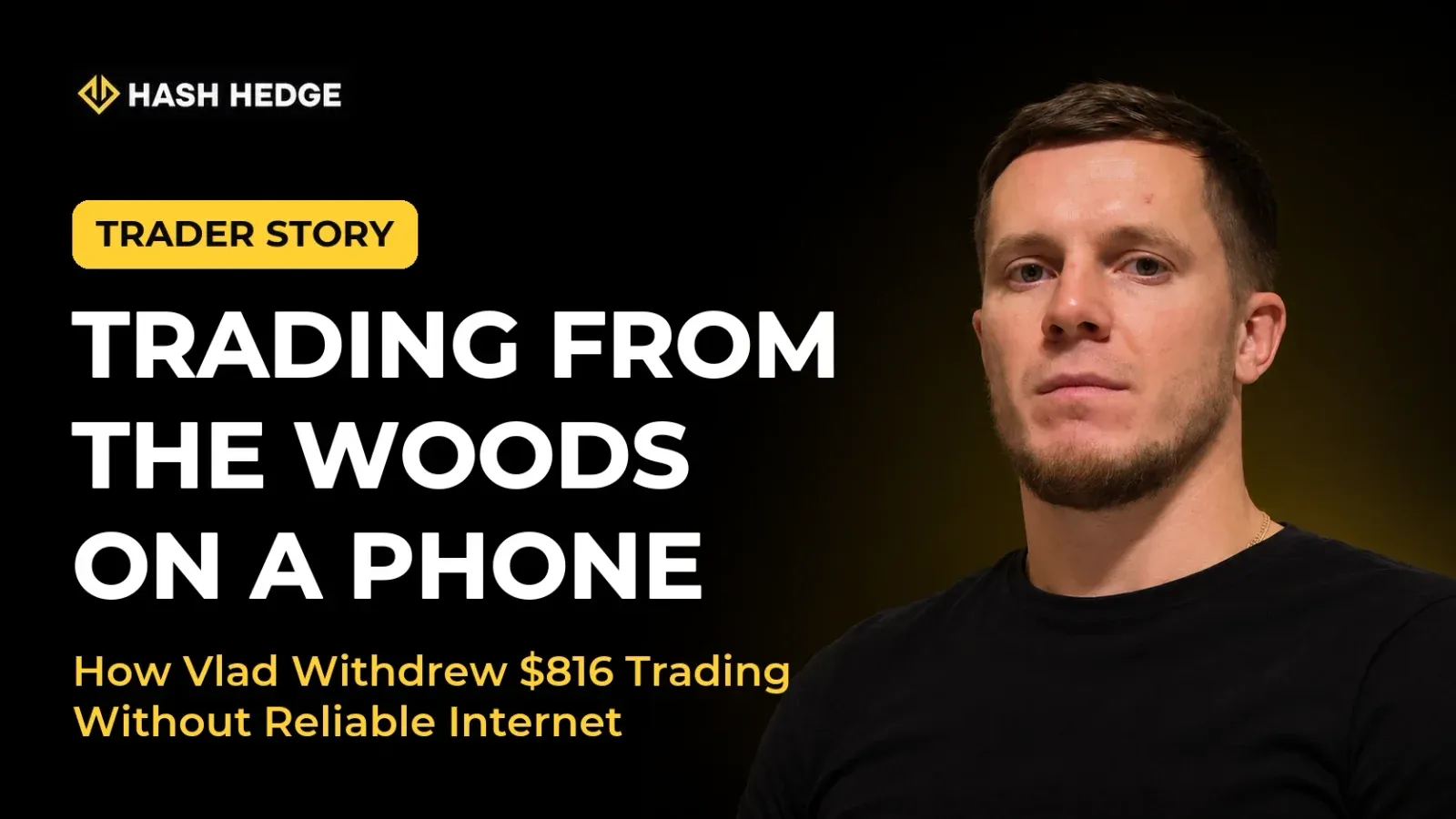
Vlad: 31 Years Old, Working in Security, and Trading “for Diapers”
Vlad works in security services, often in wooded areas, and spends a lot of time traveling. For him, trading is an additional source of income.
Even with access to substantial trading capital, Vlad doesn’t plan to leave his full-time job. He doesn’t want his entire life to depend on trading alone.
The main assets Vlad trades are:
- Bitcoin (BTC)
- Ethereum (ETH)
- Ripple (XRP)
He opens both long and short positions, depending on the direction of the trend. For analysis, he primarily uses the four-hour (H4) and daily (D1) timeframes.
He opens every trade from his phone. He also uses it to analyze charts, mark price levels, and draw technical analysis patterns.
According to Vlad, after years of trading this way, he’s become so accustomed to it that most actions are practically automatic.
“I’ve gotten really good at trading on my phone.”
From MetaTrader and Gold Trading to Crypto
Vlad started trading in 2021. He began on MetaTrader, trading gold and currency pairs. He lost his entire first deposit.
He considers gold a particularly challenging instrument. In his experience, sharp price movements can quickly wipe out a trading deposit if the entry point is poorly chosen.
“You can make really good money trading gold, but you have to anticipate everything.”
Over time, Vlad switched to cryptocurrencies and simplified his trading strategy.
Today, his analysis relies on just two patterns: flags and triangles, which he believes continue to work in the market.
Hash Hedge: From a $10,000 Challenge to an $816.29 Payout
Vlad’s journey with Hash Hedge began when he purchased a $10,000 Challenge. He successfully passed both stages, received a Funded Account, and withdrew $816.29 on June 30, 2026.

He passed Stage 1 of the $10,000 Challenge with just one XRP trade.
Vlad spent about a week watching the price and waiting for the right entry point. Rather than opening a position immediately after a breakout, he waited for the price to revisit the relevant zone.
He then opened a short position, using the entire account balance with 3x leverage.
Once he reached the Stage 1 profit target, he decided not to keep the position open and take any additional risks.
“I’m not obsessed with closing everything as quickly as possible. Once I’ve achieved my goal, I stop trading.”
After his first payout, Vlad continued trading with Hash Hedge and purchased another $10,000 Challenge. However, he was unable to complete it: he breached the loss limits and lost the account.
His next attempt was a $50,000 Challenge, which also ended unsuccessfully.
Vlad’s journey with Hash Hedge therefore includes not only successfully completing a Challenge and receiving an $816.29 payout, but also two subsequent unsuccessful attempts.
His experience shows that even after reaching the Funded Stage and receiving your first payout, success in future Challenges is never guaranteed. It’s important to follow proper risk management, stick to your trading strategy, and avoid making emotional decisions.
Two Technical Analysis Patterns: Flags and Triangles
Vlad’s strategy is built around just two technical analysis patterns: flags and triangles.
For him, an ideal flag forms when the price repeatedly touches the upper and lower boundaries in sequence: high, low, high, low, high.
After several touches, Vlad looks for an entry near a boundary: the upper boundary for shorts and the lower boundary for longs. If the price moves in his favor, he moves his stop-loss to breakeven.
His approach to triangles is even simpler.
Vlad doesn’t distinguish between ascending, descending, and symmetrical triangles.
What matters to him is that the price gradually consolidates inside the pattern, approaches a boundary, and eventually breaks through it.
He doesn’t believe it’s necessary to count every touch precisely. A few confirmations of the upper and lower boundaries are enough for him to start anticipating a breakout.
His choice of timeframe depends on the account size.
On a $10,000 Challenge, Vlad prefers intraday trading, where price movements are more noticeable. On larger accounts, he focuses on the H4 and daily charts.
However, these patterns don’t work in every situation. Vlad also pays attention to previous highs and small pullbacks, after which the price attempts to break through a key level again.
Entry Points, Stop-Losses, and Trade Management
Vlad describes his ideal entry point as “rock-solid.”
For him, that means a combination of a strong price level that has repeatedly held and a fully formed technical analysis pattern.
Before opening a position, he waits for confirmation: either a four-hour candle closing in the expected direction or the pattern playing out as anticipated.
He trusts hourly signals less because the price can still change direction before the candle closes.
While completing Challenges, Vlad often trades without setting a stop-loss in advance, preferring to manage his positions manually.
He explains that sometimes the price hits a stop-loss before reversing in the expected direction. When a trade moves against him, he therefore monitors the daily drawdown limit and tries to close the position himself.
On a $10,000 account, the daily loss limit is $500. In one of his trades, the drawdown was approximately $82.
His risk-to-reward ratio varies depending on the situation. He has had trades with ratios of 6:1, 3:1, and 3:2.
When the price makes a strong move, Vlad prefers to take his profit rather than wait for the trend to continue.
“When you get a good move, don’t wait. Take the profit and close the trade.”
However, trading without a stop-loss has already cost him money.
Once, Vlad opened a position at the airport before a flight and didn’t have time to set a protective order. At that exact moment, his internet connection dropped.
As a result, he lost money in a situation he could have prevented.
“I kept telling myself not to open trades before a flight. And then I did it anyway. If only I’d set a stop-loss… I was in too much of a hurry. That was the problem.”
Higher Risk During Challenges and More Cautious Trading on a Funded Account
Vlad admits that he deliberately increases his risk while completing Challenges.
For him, it’s part of his strategy: the main objective is to pass the evaluation as quickly as possible and reach the Funded Stage.
If Vlad feels confident about an entry point, he may open a position using 50% of the account balance with 5x leverage, and sometimes even the entire balance.
In these situations, he relies on a precise entry and expects minimal adverse price movement.
Once he reaches the Funded Stage, his approach changes. Vlad reduces his risk, uses stop-losses, and trades more cautiously.
He explains the difference in psychological terms.
“On a smaller account that you see as the company’s capital, it’s easier to stay calm about potential losses.”
But with a larger account, such as $50,000, the fear of losing money becomes stronger, even when the capital doesn’t belong to you.
Vlad has also noticed something about stop-losses. In his experience, when he places a protective order, the price often hits his stop before reversing in the direction he originally expected.
Without a stop-loss, he feels these movements happen less frequently.
However, Vlad doesn’t claim that the market actually behaves this way. He’s simply sharing his personal observations.
It’s important to understand that taking excessive risks doesn’t guarantee faster Challenge completion and can result in losing an account in a single trade.
Vlad experienced this firsthand when he lost his first $10,000 Challenge because of overly aggressive trading.
Trading from a Phone: Unreliable Internet as the Biggest Risk
For Vlad, the biggest challenge isn’t analyzing charts. It’s having an unreliable internet connection.
He often works in remote wooded areas where connectivity can disappear for extended periods.
Vlad calls the internet his “fuel.” Sometimes he has to drive or walk without access to the network, then check what happened to his open positions once the connection returns.
These days, Vlad tries to trade only when he has a stable internet connection so he can always monitor his positions.
He’s already lost money because his connection dropped while he had an open trade without a stop-loss.
His colleagues don’t know about his interest in trading, although there are no rules preventing him from trading during work.
Whenever he has free time, Vlad simply opens the app, checks the charts, and closes a position if necessary.
Key Takeaways
1. A simple strategy can work without complicated indicators.
Vlad uses just two technical analysis patterns: flags and triangles. For him, the key is to wait for a strong price level and confirmation on the four-hour chart rather than opening trades every time a pattern appears.
2. Taking higher risks can speed up Challenge completion, but it also increases the chance of losing the account.
Vlad deliberately takes on more risk during the evaluation stage to reach a Funded Account faster. Once Funded, he reduces his risk and uses stop-losses. However, he lost his first Challenge precisely because of aggressive trading.
3. Don’t open trades you won’t be able to monitor.
Trading from a phone requires paying close attention to internet connectivity. Vlad lost money after opening a position without a stop-loss at an airport before a flight. Now, he tries to trade only when he has a stable connection.
4. Your first payout isn’t the final goal. It’s a step toward further growth.
After receiving $816.29, Vlad used part of the money to purchase another Challenge. For him, trading remains an additional source of income that he balances with his full-time job and family life.